Species · Small Pet
Gerbil
Meriones unguiculatus
Mongolian desert rodent, kept since the 1960s and built by evolution to dig, hoard and never waste a drop of water.
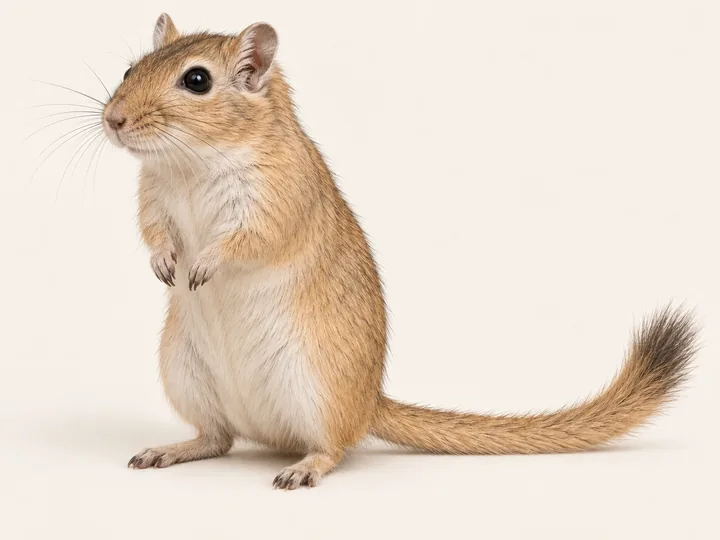
The gerbil’s whole design brief is desert: it drinks little, produces almost no smell, and it digs — really digs, tunnels-and-chambers digs — which is why the single biggest upgrade you can give one is not a toy but a tank half-filled with diggable bedding. They are sociable, diurnal enough to actually see, and hardy, with a couple of handling rules that matter more than everything else: same-sex pairs introduced young, and never, ever, lifted by the tail.
At a glance
- Lifespan
- 3–4 years
- Adult weight
- 70–110 g
- Daily attention
- 30–60 min, plus watching the excavation
- Alone time tolerated
- Keep in same-sex pairs from young
- Minimum housing
- Glass tank with deep diggable bedding
- Diet
- Gerbil mix rationed, plus greens
- Handling
- Scoop with both hands — never the tail
- With children
- Good for gentle school-age kids, supervised
- With other pets
- Prey animal — keep separate
Breeds · 4 listed
Golden agouti is the wild look; black, lilac and spotted are common mutations. Same animal, same tunnels.
-
Golden agouti
-
Black
-
Lilac
-
Spotted
Right for you if
- Watching animals genuinely build something appeals to you.
- A pair introduced young, in a tank with deep bedding, is the setup you will actually provide.
- Low odour matters — this is the least smelly rodent here.
- A three-to-four-year commitment fits the household.
Wrong for you if
- The cage on offer is a shallow tray with a wheel.
- You want a solitary pet; a lone gerbil is a diminished one.
- Small children would grab rather than scoop.
- You have not checked whether gerbils can be kept where you live.
Welfare and sourcing — read this part
- Seizures occur in roughly 20 to 40% of gerbils, though they are uncommon in many pet strains — brief freezing or twitching episodes, usually outgrown or managed by reducing stress.1 Ask the breeder plainly whether their lines seize; established pet lines mostly do not.
- Never pick a gerbil up by the tail: the skin can strip — “tail slip” — and it does not grow back.1 Scoop with both hands, and teach children the same before they touch.
- Older gerbils may develop tumours of the scent gland on the belly, benign or malignant.1 A quick weekly look at the ventral gland is the whole screening program.
- Whether you can keep a gerbil at all differs from place to place, including within Australia. Check what applies where you live before you commit.
Sources
- Disorders and Diseases of Gerbils. MSD Veterinary Manual 2026. Accessed 2026-09-05. International MSD Veterinary Manual Seizures occur in about 20% to 40% of gerbils, though they are uncommon in many pet strains. Picking a gerbil up by the tail can strip the skin — “tail slip”. Older gerbils may develop tumours of the ventral marking gland, benign or malignant.
Every source here was checked, not recalled. Where this page makes a health statement and no source appears against it, that is not an oversight we have hidden — it means the claim is not yet sourced, and the build reports how many are in that state.
Availability, registration and keeping requirements differ from place to place. Check the rules where you live before you commit to any animal — we describe animals, not law.