Species · Small Pet
Ferret
Mustela furo
Domesticated polecat, working rabbiter for two thousand years and a chaotic, affectionate housemate for the last fifty.
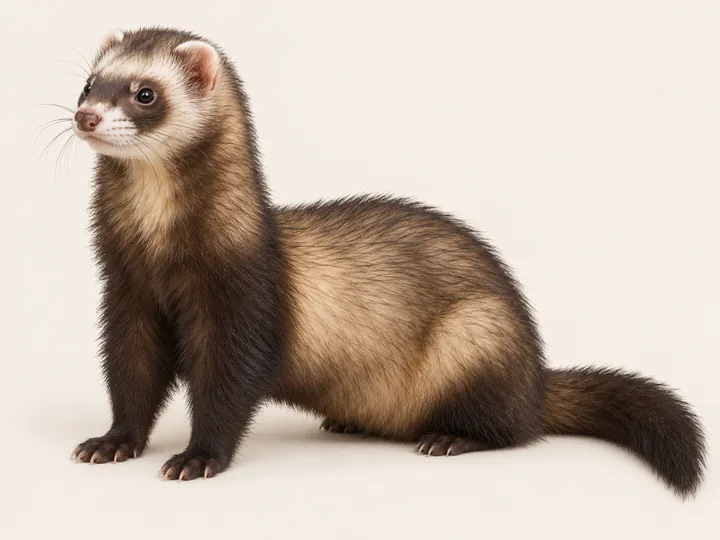
A ferret is the most dog-like thing on this page: it plays, it greets you, it invents games, and it does all of it in a body that can pour itself through a gap the width of a broom handle. It sleeps eighteen hours and spends the other six committing burglary. The honest half of the page is medical — this is a species whose middle age is defined by hormonal disease, and whose keeping is not legal everywhere. Budget for the vet from day one and check your state before you fall in love.
At a glance
- Lifespan
- 5–9 years
- Adult weight
- 0.7–2 kg
- Daily attention
- 2–4 hrs of supervised chaos daily
- Alone time tolerated
- Keep in pairs; they sleep in heaps
- Minimum housing
- Large cage plus a ferret-proofed room
- Diet
- Obligate carnivore — meat, not muesli
- Handling
- Robust and wriggly; most love it
- With children
- Robust older children; play-nips need managing
- With other pets
- Never with birds or small mammals; some live with cats and dogs
Breeds · 4 listed
Sable, albino, silver and more — coat colours on the same animal. What matters more is desexing status and where the ferret came from.
-
Sable
-
Albino
-
Silver
-
Cinnamon
Right for you if
- You want an interactive, playful pet and are home enough to supervise it.
- A ferret-proofed room — gaps, cables, rubber and washing machines audited — is achievable.
- Mid-life vet bills are budgeted, not hoped against.
- Two ferrets sounds better than one, because it is.
Wrong for you if
- Birds, rabbits or rodents share the house; a ferret is their predator, always.
- The musky scent, even in a desexed ferret, would wear on you.
- Nobody can supervise free-range time daily.
- You have not checked whether ferrets can be kept where you live.
Welfare and sourcing — read this part
- Insulinomas — pancreatic tumours that crash blood sugar — are very common in ferrets past three years old, and adrenal disease appears from as young as eighteen months, classically as hair loss starting at the tail.1 A weak, glassy-eyed ferret or a balding tail is a vet visit; middle age in this species comes with a watch list.
- An entire female that stays in season is at real risk: bone marrow suppression may follow severe elevation of oestrogen.1 Desexing questions are welfare questions in this species — ask the seller exactly how and when it was, or will be, handled.
- Ask what the ferret is fed and expect meat in the answer — this is an obligate carnivore. Ask about vaccination and parasite cover for your area while you are at it; a good keeper answers both without blinking.
- Whether you can keep a ferret at all differs from place to place, including within Australia. Check what applies where you live before you commit.
Sources
- Hormonal Disorders of Ferrets. MSD Veterinary Manual 2024. Accessed 2026-09-05. International MSD Veterinary Manual Insulinomas — pancreatic tumours causing low blood sugar — are very common in ferrets older than three. Adrenal gland disease can be seen from as young as 1.5 years, with hair loss starting at the tail and moving up; bone marrow suppression may follow severe elevation of oestrogen levels.
Every source here was checked, not recalled. Where this page makes a health statement and no source appears against it, that is not an oversight we have hidden — it means the claim is not yet sourced, and the build reports how many are in that state.
Availability, registration and keeping requirements differ from place to place. Check the rules where you live before you commit to any animal — we describe animals, not law.