Breed · Dog
Poodle
German water retriever polished in France into three sizes. The haircut was for swimming before it was for show.
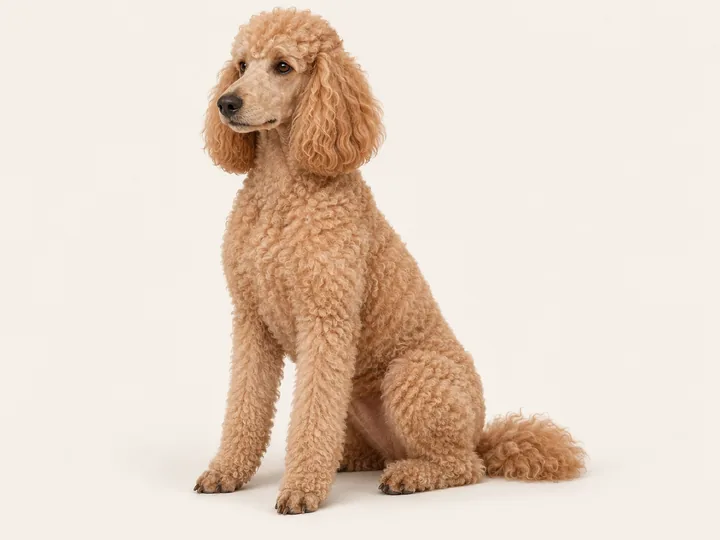
Strip away the topiary and the Poodle is a working retriever with one of the sharpest minds in dogdom — athletic, funny, intensely people-focused, and available in three sizes so the same brain fits any home. The coat that does not shed instead grows, forever, which means clipping every six weeks for life. Choose the size honestly: a Standard is a genuine sporting dog with a sporting dog’s needs, a Toy is a companion with surprising spark, and the Miniature sits between as possibly the best-kept secret in family dogs.
At a glance
- Lifespan
- 12–16 years; longer in the small sizes
- Adult weight
- Toy 3–4 kg; Miniature 6–9 kg; Standard 20–32 kg
- Daily exercise
- Toy 45 min; Standard 2 hrs
- Trainability
- Exceptional, all sizes
- Alone time tolerated
- Moderate; the brain objects before the body
- Shedding
- Minimal — but the coat grows instead
- Noise level
- Moderate; an alert announcer
- With children
- Very good; match the size to the child
- With other pets
- Very good
Colours · 5 listed
Three sizes, one breed, solid colours across all of them. The size decision changes exercise, lifespan and cost more than any colour decision on this site.
-
Black
-
White
-
Apricot
-
Red
-
Silver
Right for you if
- You want a highly trainable dog and will feed the brain daily, not just the body.
- Low shedding matters — allergies, or just the furniture.
- A six-weekly grooming bill, or learning to clip, is a settled question.
- You picked the size for your actual household, not the photo you liked.
Wrong for you if
- Grooming money and grooming time are both scarce; the coat cannot be opted out of.
- You bought a Standard for a Toy lifestyle — that is a sporting dog on a sofa schedule.
- A clever, slightly needy shadow would annoy you.
- You are embarrassed by the breed’s image. The dog will notice nothing; you will.
What to ask a breeder
- For Standards, the UK Kennel Club lists PRA DNA tests (both rcd4 and prcd), the von Willebrand disease DNA test, eye testing and hips — and enforces PRA status on imports, with carriers only bred to clear dogs.1 For Toys, the prcd-PRA DNA test is the good-practice entry, with eyes and hips alongside.2
- For Standards, ask by name what the breeder does about bloat risk and sebaceous adenitis in their lines. For Toys and Miniatures, ask for patella grades — no scheme lists them, which makes the question more worth asking, not less.
- Ask to see the parents in a plain pet clip if you can. You are buying the dog, not the sculpture, and a breeder relaxed about that request is usually the right kind.
Sources
- Poodle (Standard) — breed health and pre-breeding screening. The Royal Kennel Club 2026. Accessed 2026-09-04. United Kingdom The Royal Kennel Club The UK Kennel Club's published screening lists for the breed: best practice is PRA DNA tests (rcd4 and prcd), vWD1 DNA, eye testing and hips; imported dogs and overseas sires must certify PRA status, and carriers may only be mated to clear dogs.
- Poodle (Toy) — breed health and pre-breeding screening. The Royal Kennel Club 2026. Accessed 2026-09-04. United Kingdom The Royal Kennel Club The UK Kennel Club's published screening lists for the breed: good practice is the prcd-PRA DNA test; best practice adds eye testing and hips. No patella test is listed.
Every source here was checked, not recalled. Where this page makes a health statement and no source appears against it, that is not an oversight we have hidden — it means the claim is not yet sourced, and the build reports how many are in that state.
Availability, registration and keeping requirements differ from place to place. Check the rules where you live before you commit to any animal — we describe animals, not law.