Breed · Dog
Irish Wolfhound
The ancient wolf-courser of Ireland, rebuilt in the 1800s from near-extinction into the tallest breed there is.
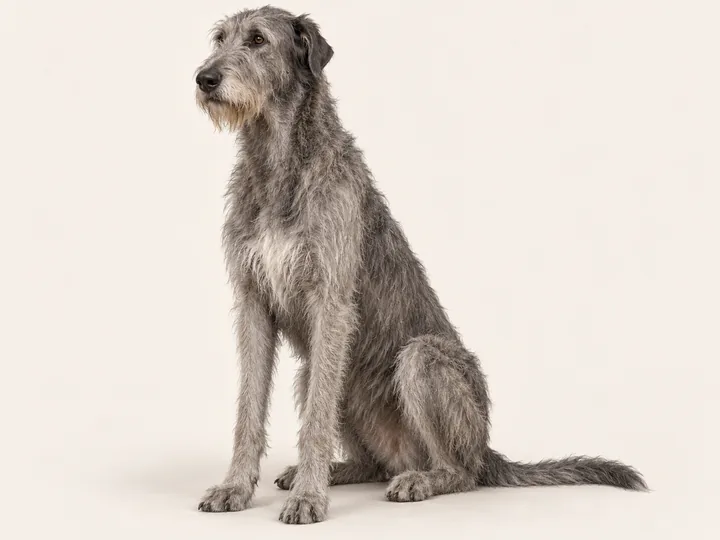
Nothing prepares you for how much dog an adult Wolfhound is, or how little of it is bluster: this is a calm, courteous, alarmingly gentle animal that believes it is a lapdog and is only wrong logistically. The price is the calendar. Giants compress a dog’s life, and the Wolfhound’s compression is the steepest in dogdom — the honest conversation with a breeder is about hearts, bloat and what their dogs died of, had early, and how they handled it. People who have owned one tend to own another anyway. That tells you what the years are worth.
At a glance
- Lifespan
- 6–10 years
- Adult weight
- 40–70 kg
- Daily exercise
- 60–90 min, gently while growing
- Trainability
- Good; train it before month eight, not after
- Alone time tolerated
- Moderate
- Shedding
- Moderate wiry coat
- Noise level
- Very low
- With children
- Excellent — supervise for sheer scale
- With other pets
- Good; sighthound chase lives in there
Colours · 4 listed
Grey and brindle are the postcards; every colour is the same enormous dog.
-
Grey
-
Brindle
-
Red
-
Fawn
Right for you if
- You have the space, the car, the budget and the arm for a truly giant dog.
- Calm, quiet company is the point — this is not an action breed.
- You will learn the bloat drill cold and have the emergency vet’s number pinned up.
- You can love hard on a short clock, knowingly.
Wrong for you if
- The budget is tight; every line item on this page is giant-sized.
- You are not ready to face the lifespan on the glance card above.
- Stairs, small cars and low ceilings frame your life.
- You want a guard dog. It will watch the burglar work with grave interest.
What to ask a breeder
- Bloat is a giant-breed emergency with numbers behind it: in a prospective cohort of eleven large and giant show breeds — the Irish Wolfhound among them — it struck at 23 to 26 cases per 1,000 dog-years and killed 28.6% of the dogs it struck.1 Learn the signs before the dog comes home.
- The UK Kennel Club’s lists for the breed are genetic diversity and eye testing — no cardiac test appears on them, and the page hands the rest to the breed club’s own health scheme.2 So the heart question is yours to ask: what screening, by whom, how often, and what their dogs have died of and when. Judge the breeder by how readily the answer comes.
- Ask how the breeder raises giant puppies — slow, lean growth on measured food, no forced exercise while the frame is building. The right breeder delivers this lecture before you can ask for it.
Sources
- Glickman LT, Glickman NW, Schellenberg DB, Raghavan M, Lee TL. Incidence of and breed-related risk factors for gastric dilatation-volvulus in dogs. Journal of the American Veterinary Medical Association 2000. International doi:10.2460/javma.2000.216.40 PMID 10638316 A prospective cohort of 1,914 show dogs of 11 large and giant breeds including the Great Dane: bloat incidence was 23–26 cases per 1,000 dog-years, risk rose with age, and 28.6% of the dogs that bloated died of it.
- Irish Wolfhound — breed health and pre-breeding screening. The Royal Kennel Club 2026. Accessed 2026-09-04. United Kingdom The Royal Kennel Club Good practice is prioritising genetic diversity; best practice adds eye testing. No cardiac test appears on either list; the page points to the breed club’s own health scheme for more.
Every source here was checked, not recalled. Where this page makes a health statement and no source appears against it, that is not an oversight we have hidden — it means the claim is not yet sourced, and the build reports how many are in that state.
Availability, registration and keeping requirements differ from place to place. Check the rules where you live before you commit to any animal — we describe animals, not law.