Breed · Dog
Greyhound
An ancient sighthound type, and in modern Australia most commonly met as a retired racing dog looking for a home.
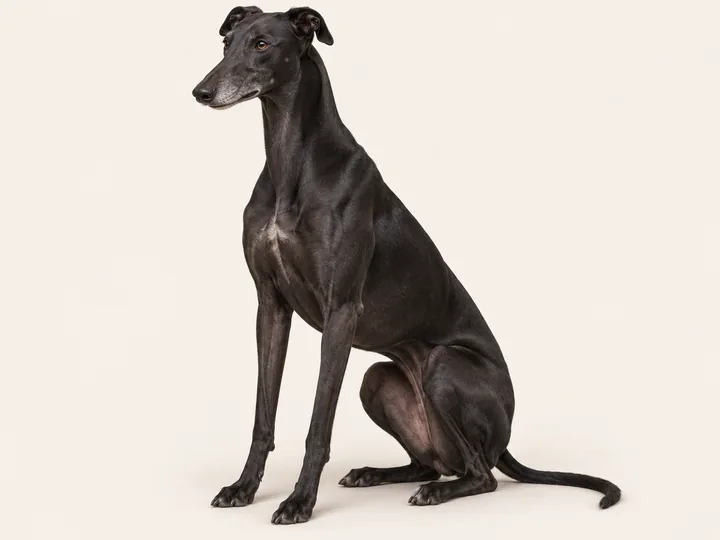
The best-kept secret in dogs. Greyhounds are quiet, clean, low-shedding, affectionate and — despite every expectation — genuinely lazy. Two short walks and a sprint in a safe enclosure suits most of them; the rest of the day is spent asleep on the largest soft surface available. The catch is prey drive, which is real, individual, and the thing to be honest about before there is a cat in the house.
At a glance
- Lifespan
- 10–14 years
- Adult weight
- 25–40 kg
- Daily exercise
- 30–60 min
- Trainability
- Moderate, independent
- Alone time tolerated
- Good
- Shedding
- Low
- Noise level
- Very quiet
- With children
- Gentle, needs a quiet home
- With other pets
- Cat-safe or not — ask
Colours · 6 listed
Racing selected for speed and nothing else, so the colour range is wide and carries no meaning at all.
-
Black
-
Blue
-
Fawn
-
Red
-
Brindle
-
White & ticked
Right for you if
- You want a large dog with genuinely modest exercise needs.
- You want to adopt an adult with a known temperament.
- You want a quiet household and a dog that suits it.
- You can offer somewhere soft and warm — they have no body fat.
Wrong for you if
- You want a jogging partner. They sprint, they do not endure.
- You have cats or small pets and the dog has not been assessed with them.
- You want off-lead freedom in unfenced spaces. A sighthound in pursuit does not hear you.
- Your home is cold. These dogs need coats, indoors sometimes.
Adoption and health — the specific questions to ask
- Ask the adoption group specifically how the dog tested with cats and small dogs. Good groups assess this properly and will tell you plainly.
- Greyhounds react differently to some anaesthetics — on thiobarbiturates they took three to four times longer to stand than other dogs, some over eight hours1 — and their normal bloodwork ranges genuinely differ from other breeds.2 Make sure your vet knows the breed before any procedure.
- Retired racers often come with dental disease: in UK primary-care records, periodontal disease was the most prevalent disorder in the breed, recorded in 39% of greyhounds in a single year.3 Assume a dental is due, and budget for it in year one.
- Muzzle and registration requirements for greyhounds differ from place to place — check what applies where you live before you adopt.
Sources
- Robinson EP, Sams RA, Muir WW. Barbiturate anesthesia in greyhound and mixed-breed dogs: comparative cardiopulmonary effects, anesthetic effects, and recovery rates. American Journal of Veterinary Research 1986; 47(10):2105-12. International PMID 3777630 Greyhounds compared with weight-matched mixed-breed dogs under four barbiturates. Greyhounds took three to four times longer to stand after thiobarbiturates, some more than eight hours. Specific to barbiturates, not to every modern agent.
- Zaldivar-Lopez S, Marin LM, Iazbik MC, Westendorf-Stingle N, Hensley S, Couto CG. Clinical pathology of Greyhounds and other sighthounds. Veterinary Clinical Pathology 2011; 40(4):414-425. International doi:10.1111/j.1939-165X.2011.00360.x PMID 22092909 Retired racing Greyhounds differ from other breeds across many blood values — higher red cell mass, creatinine and liver enzymes; lower white cell, neutrophil and platelet counts.
- O’Neill DG, Rooney NJ, Brock C, Church DB, Brodbelt DC, Pegram C. Greyhounds under general veterinary care in the UK during 2016: demography and common disorders. Canine Genetics and Epidemiology 2019. United Kingdom doi:10.1186/s40575-019-0072-5 PMID 31179010 VetCompass records for 5,419 UK pet greyhounds — a population kept largely after racing careers: periodontal disease was the most prevalent disorder of all, recorded in 39.0% in a single year, ahead of overgrown nails, wounds and osteoarthritis.
Every source here was checked, not recalled. Where this page makes a health statement and no source appears against it, that is not an oversight we have hidden — it means the claim is not yet sourced, and the build reports how many are in that state.
Availability, registration and keeping requirements differ from place to place. Check the rules where you live before you commit to any animal — we describe animals, not law.