Breed · Dog
German Shepherd
German herding breed standardised in 1899 and turned into the world’s default working dog — police, military, assistance, search.
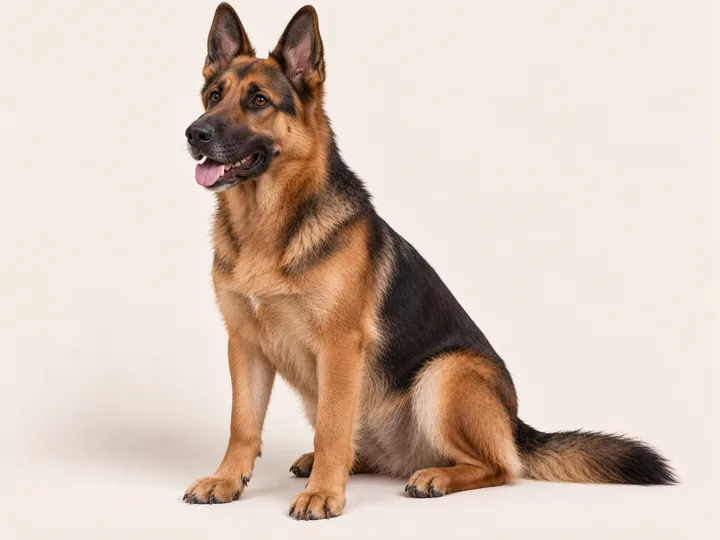
At its best, the German Shepherd is everything the reputation promises: intelligent, loyal to the bone, steady under pressure, endlessly trainable. The breed’s size and fame have also made it one of the most carelessly bred dogs alive, and the gap between a well-bred Shepherd and a badly bred one is wider than in almost any breed — in temperament, in nerves, and in hips. The dog deserves a household with real work and an owner who chose the breeder like it mattered, because it does.
At a glance
- Lifespan
- 9–13 years
- Adult weight
- 22–40 kg
- Daily exercise
- 2 hrs, plus mental work
- Trainability
- Exceptional
- Alone time tolerated
- Moderate with training, poor without
- Shedding
- Constant, with biannual blizzards
- Noise level
- Moderate to high; a talker
- With children
- Very good with its own family
- With other pets
- Good when raised together
Colours · 4 listed
Black-and-tan saddles, sables, solid blacks; stock coat and long coat. Working lines and show lines differ more than any colour does — the show ring’s sloped back is its own controversy, and you can simply not buy it.
-
Black & tan
-
Sable
-
Black
-
Long coat
Right for you if
- You want a true partner dog for training, sport, or serious daily work.
- Two hours a day of body-and-brain exercise is sustainable for a decade.
- You will pick lines for stable temperament and level backs, and pay for the privilege.
- Hair, everywhere, forever, is a price you accept.
Wrong for you if
- The dog would guard a yard alone. An under-worked, under-socialised Shepherd is a liability, not a guard.
- Nervy, reactive dogs frighten you — badly bred examples of this breed lean exactly that way.
- The vacuuming schedule cannot double.
- First dog, busy household, thin margins for training time.
What to ask a breeder
- Hip and elbow scoring under the BVA/KC schemes is the UK Kennel Club’s good-practice minimum for this breed, with degenerative myelopathy DNA and eye testing alongside.1 Ask for both parents’ scores in writing and compare them against the scheme averages yourself.
- Ask to meet the mother and judge her nerves in person: steady, curious and recovered within moments of a surprise is what you are looking for. Temperament is the other heritable organ.
- Look at the backs of the parents — choose level over extreme, whatever the show ring rewards.
Sources
- German Shepherd Dog — breed health and pre-breeding screening. The Royal Kennel Club 2026. Accessed 2026-09-04. United Kingdom The Royal Kennel Club The UK Kennel Club's published screening lists for the breed: good practice is hip and elbow testing under the BVA/KC schemes; best practice adds degenerative myelopathy DNA and eye testing.
Every source here was checked, not recalled. Where this page makes a health statement and no source appears against it, that is not an oversight we have hidden — it means the claim is not yet sourced, and the build reports how many are in that state.
Availability, registration and keeping requirements differ from place to place. Check the rules where you live before you commit to any animal — we describe animals, not law.