Breed · Dog
Dachshund
German badger-hunting hound — the name says exactly that — built long and low to follow quarry underground.
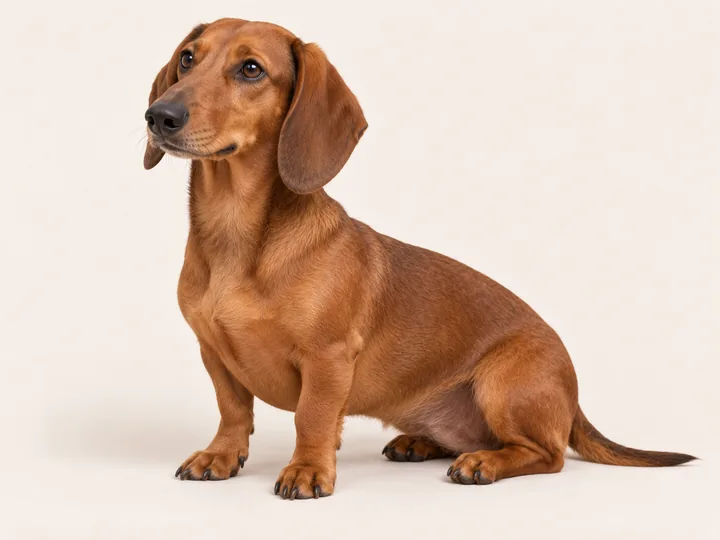
Dachshunds are brave, funny, loyal little hounds with a full-sized opinion of themselves, and they have surged back into fashion. The shape that makes them is also the shape that breaks them: that long back rides on dwarfed legs, and how you manage jumping, stairs and weight is not a detail of Dachshund ownership — it is most of it. Buy from a breeder who talks about backs before you ask, and set the house up for the spine on day one.
At a glance
- Lifespan
- 12–16 years
- Adult weight
- 4–9 kg standard; less for miniatures
- Daily exercise
- 45–60 min, on the flat
- Trainability
- Moderate; a hound first
- Alone time tolerated
- Moderate; vocal when bored
- Shedding
- Light to moderate by coat
- Noise level
- High — a genuinely big bark
- With children
- Good with respectful children
- With other pets
- Good with dogs; small furries are quarry
Colours · 4 listed
Two sizes, three coats — smooth, long and wire — and the same dog under all of them. Wires lean cheekier, longs lean softer, and every one of them believes it is in charge.
-
Red
-
Black & tan
-
Chocolate & tan
-
Wheaten (wire)
Right for you if
- You want a small dog with actual character, not an ornament.
- You will ramp the sofa, gate the stairs and police the waistline without fail.
- A dog that announces every visitor suits the household.
- You accept that recall is a negotiation with a hound.
Wrong for you if
- The house is all stairs and the children are all bounce.
- You will let it jump off furniture because stopping it is a hassle. That is the one job.
- A barking dog and close neighbours are already a tension.
- You want an off-lead park dog that ignores scent and small animals.
What to ask a breeder
- The back risk is conformational and measurable: the longer a dog’s back relative to its height, the higher its risk of disc extrusion, with being overweight and being miniaturised each adding to it.1 Managing jumping, stairs and weight is not fussing — it is acting on the breed’s core finding.
- The UK Kennel Club runs a dedicated IVDD spine-screening scheme for the breed, supported by Dachshund Health UK, and has refused dapple-to-dapple registrations since 2010.2 A Dachshund breeder who cannot talk about spine screening has not met their own breed’s paperwork.
- Ask to see both parents move and jump down from a low step. Free, easy movement in the parents is the most honest structural evidence you will get.
Sources
- Packer RMA, Hendricks A, Volk HA, Shihab NK, Burn CC. How long and low can you go? Effect of conformation on the risk of thoracolumbar intervertebral disc extrusion in domestic dogs. PLoS ONE 2013. International doi:10.1371/journal.pone.0069650 PMID 23894518 In 700 referral dogs, the longer a dog’s back relative to its height, the higher its risk of thoracolumbar disc extrusion; being overweight and being skeletally smaller each further increased risk. Miniature Dachshund probabilities are modelled directly.
- Dachshund (Smooth Haired) — breed health and pre-breeding screening. The Royal Kennel Club 2026. Accessed 2026-09-04. United Kingdom The Royal Kennel Club The UK Kennel Club's published screening lists for the breed: good practice is genetic diversity and spine screening under the KC IVDD screening scheme (supported by Dachshund Health UK); best practice adds eye testing. Registration from dapple-to-dapple matings has been refused since 2010.
Every source here was checked, not recalled. Where this page makes a health statement and no source appears against it, that is not an oversight we have hidden — it means the claim is not yet sourced, and the build reports how many are in that state.
Availability, registration and keeping requirements differ from place to place. Check the rules where you live before you commit to any animal — we describe animals, not law.