Breed · Dog
Bulldog
English bull-baiting dog rebuilt into a companion after the sport was banned in 1835. The modern shape is a show-ring creation, not a working one.
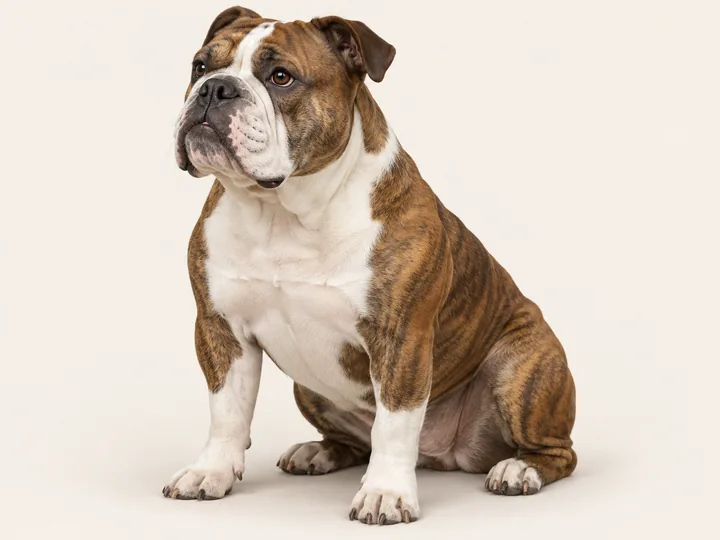
It is easy to see why people fall for Bulldogs: few breeds are as patient, as comfortable with children, or as content with a modest walk and a long nap. The honest half of the page is the body. The flat face, the tight nostrils, the heavy folds and the narrow hips are all things the show ring selected for, and every one of them asks the dog to pay for our taste. If you want this breed, your whole job is to find the breeder working to give it back its breathing room — they exist, and the difference between their dogs and the cheap ones is the difference between a companion and a patient.
At a glance
- Lifespan
- 8–10 years
- Adult weight
- 18–25 kg
- Daily exercise
- 30–45 min, gently, out of the heat
- Trainability
- Moderate; amiable but immovable
- Alone time tolerated
- Good
- Shedding
- Moderate
- Noise level
- Low bark, high snore
- With children
- Excellent
- With other pets
- Generally easy
Colours · 4 listed
Colour is the least important decision on this page. Walk past any advertisement selling a Bulldog by colour, especially an unrecognised one at a premium.
-
Brindle & white
-
Red & white
-
Fawn
-
White
Right for you if
- You want a calm, deeply tolerant companion for a quiet household.
- Your climate is mild, or your house is air-conditioned and you accept walks are for mornings.
- You are prepared to interrogate breeders and wait for the right one.
- A dog that snores in every room you are in sounds like company.
Wrong for you if
- You want a jogging or hiking partner.
- Summer is hot where you live and the dog would live outside. That is not a Bulldog life.
- The budget stops at the purchase price — this is a breed to insure on day one.
- You are buying on impulse. This breed punishes an unresearched purchase more than almost any other.
What to ask a breeder
- Airway risk in flat-faced breeds is a dose-response: it climbs sharply as the muzzle shortens, and in a 700-dog study BOAS occurred only in dogs whose muzzles were shorter than half their cranial length — with obesity adding risk on top.1 This is why the shape itself, not bad luck, is the thing to buy against.
- The UK Kennel Club lists breathing assessment under its Respiratory Function Grading scheme as good practice for the breed, refuses merle registrations, and holds the breed in its highest conformational-concern category.2 A breeder with RFG grades to show you is the breeder the breed needs.
- Listen to both parents breathe, at rest, in person. A Bulldog you can hear across a quiet room is telling you what its puppies will inherit. Walk away from any breeder who will not let you meet the parents.
- Ask how the litter was whelped, and look at the parents’ folds and tail pockets yourself. Clean, dry and unmarked is what good management looks like.
Sources
- Packer RMA, Hendricks A, Tivers MS, Burn CC. Impact of facial conformation on canine health: brachycephalic obstructive airway syndrome. PLoS ONE 2015. International doi:10.1371/journal.pone.0137496 PMID 26509577 Across 700 dogs of diverse breeds plus 154 brachycephalic dogs, BOAS risk rose sharply and non-linearly as relative muzzle length shortened, and occurred only in dogs whose muzzles were less than half their cranial length. Thicker necks and obesity independently increased risk.
- Bulldog — breed health and pre-breeding screening. The Royal Kennel Club 2026. Accessed 2026-09-04. United Kingdom The Royal Kennel Club The UK Kennel Club's published screening lists for the breed: good practice is breathing testing under the KC Respiratory Function Grading scheme plus eye testing; best practice adds HUU DNA, hips and elbows. Merle registration is refused. Breed Watch Category 3.
Every source here was checked, not recalled. Where this page makes a health statement and no source appears against it, that is not an oversight we have hidden — it means the claim is not yet sourced, and the build reports how many are in that state.
Availability, registration and keeping requirements differ from place to place. Check the rules where you live before you commit to any animal — we describe animals, not law.