Breed · Dog
Basset Hound
French scent hound bred low to the ground so hunters on foot could keep up. The droop is functional; the cartoon came later.
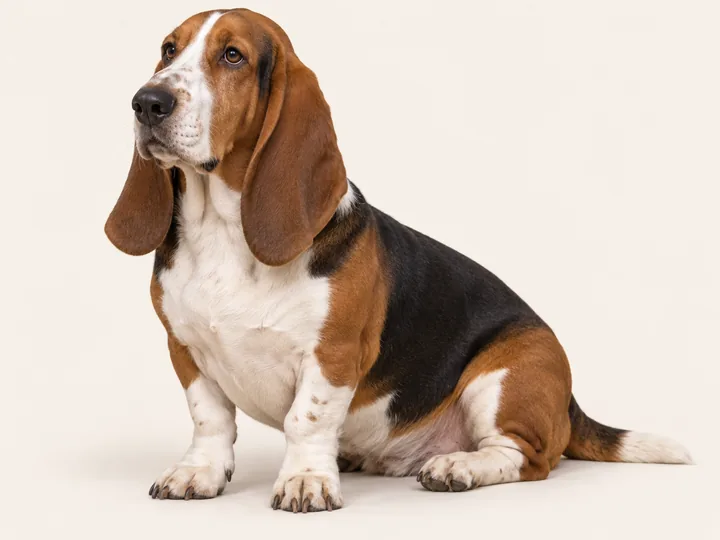
Make no mistake about the size: a Basset is a big, heavy hound on the shortest possible legs, with a big hound’s voice, appetite and opinion of interesting smells. The temperament is superb — patient, sociable, wonderful with children — and the shape is the homework. Long and low carries known costs in the back department, the folds and ears need actual maintenance, and the eyes droop enough that the register’s own watchlist has the breed in its highest conformational-concern category. Choose moderate over extreme and the Basset is one of the easiest-going hounds in the book.
At a glance
- Lifespan
- 10–12 years
- Adult weight
- 20–29 kg
- Daily exercise
- 60 min, unhurried, on the flat
- Trainability
- Moderate; the nose votes first
- Alone time tolerated
- Poor alone; bred for a pack
- Shedding
- Moderate, year-round
- Noise level
- High — a genuine baying voice
- With children
- Excellent
- With other pets
- Very good with dogs; fine with confident cats
Colours · 3 listed
Tricolour and lemon-and-white are the classics. Nothing about the colour changes the maintenance.
-
Tricolour
-
Lemon & white
-
Red & white
Right for you if
- You want a patient, comedic, deeply tolerant family hound.
- Another dog or near-constant company is part of the household.
- Ears wiped, folds checked, eyes looked at — weekly, without fail — sounds like reasonable rent.
- Your idea of a walk is a mooch with a connoisseur of smells.
Wrong for you if
- Stairs everywhere and a sofa it will be allowed to launch from.
- You will free-feed a food-obsessed hound and hope for the best.
- The neighbours share a wall and a low opinion of baritone singing.
- You want brisk hikes. The chassis says no.
What to ask a breeder
- Long-and-low is a measured risk, not a style note: the longer a dog’s back relative to its height the higher its risk of disc extrusion, with excess weight adding more — and the Basset is one of the chondrodystrophic breeds that work names directly.1 Ramps, no stair launches, and a waistline are the whole job.
- The UK Kennel Club lists eye testing with gonioscopy as good practice for the breed, with DNA tests for Lafora disease and primary open-angle glaucoma alongside — and holds the breed in its highest conformational-concern category, which is the register telling you to choose moderate over extreme.2
- Look at both parents in person: eyes without pronounced droop or redness, clean dry folds, front feet that point mostly forwards. Moderation is visible, and you are allowed to select for it.
Sources
- Packer RMA, Hendricks A, Volk HA, Shihab NK, Burn CC. How long and low can you go? Effect of conformation on the risk of thoracolumbar intervertebral disc extrusion in domestic dogs. PLoS ONE 2013. International doi:10.1371/journal.pone.0069650 PMID 23894518 In 700 referral dogs, the longer a dog’s back relative to its height, the higher its risk of thoracolumbar disc extrusion; being overweight and being skeletally smaller each further increased risk. Miniature Dachshund probabilities are modelled directly.
- Basset Hound — breed health and pre-breeding screening. The Royal Kennel Club 2026. Accessed 2026-09-04. United Kingdom The Royal Kennel Club Good practice is eye testing with gonioscopy for glaucoma predisposition; best practice adds DNA tests for Lafora disease and primary open-angle glaucoma (POAG-3) plus elbow scoring. The breed sits in Breed Watch Category 3, the register’s highest level of conformational concern.
Every source here was checked, not recalled. Where this page makes a health statement and no source appears against it, that is not an oversight we have hidden — it means the claim is not yet sourced, and the build reports how many are in that state.
Availability, registration and keeping requirements differ from place to place. Check the rules where you live before you commit to any animal — we describe animals, not law.