Breed · Dog
Australian Shepherd
American ranch dog despite the name, refined in the western United States. The name stuck via Basque shepherds who came through Australia.
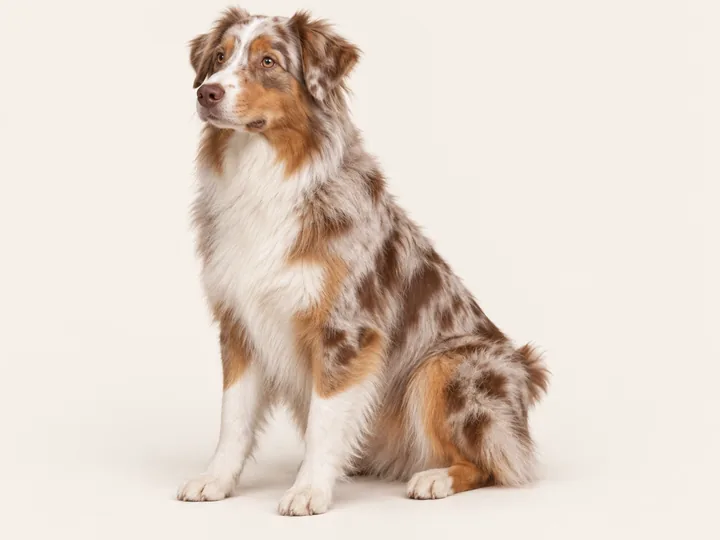
The Aussie is striking to look at and endlessly willing, which is the trap: the merle coat sells the dog, and the herding engine underneath comes as a surprise. It wants to be with you, working with you, all day. It is softer-edged than a Kelpie or Cattle Dog and makes a genuine family companion — but only for families whose idea of a good weekend involves being outdoors with the dog in it.
At a glance
- Lifespan
- 12–15 years
- Adult weight
- 16–29 kg
- Daily exercise
- 90 min plus, and a job
- Trainability
- Very high
- Alone time tolerated
- Poor; bred to shadow you
- Shedding
- Heavy, seasonal blowouts
- Noise level
- Moderate to high
- With children
- Very good, may herd them
- With other pets
- Good
Colours · 4 listed
Merle is a coat pattern, not just a colour, and it comes with a hard breeding rule: two merles must never be bred together. A breeder who shrugs at that sentence is not a breeder to buy from.
-
Blue merle
-
Red merle
-
Black tri
-
Red tri
Right for you if
- The dog joins your actual life — hiking, sport, farm work, long days outside.
- You want an affectionate, trainable dog and will spend the energy budget it comes with.
- Weekly brushing and seasonal fur snowstorms are acceptable.
- Someone is around most of the day.
Wrong for you if
- You are buying the coat. The coat comes with the dog.
- The house is empty through the working day.
- You want calm indoors without an hour and a half of output first.
- You are not prepared to vet a breeder hard on merle-to-merle matings.
What to ask a breeder
- Two merles must never be mated. Doubled merle is tied to deafness — among Strain’s hearing-tested merles, one double merle in four was deaf in one or both ears, against under 4% of singles1 — and the UK Kennel Club has refused registration of puppies from merle-to-merle matings born since 2013.2 Ask the breeder to explain their colour pairings and listen for competence.
- The collie-lineage drug-sensitivity mutation, mdr1-1Δ, runs through the sheepdog breeds — identical by descent from a single dog that predates the breed registries.3 The UK Kennel Club lists the MDR1 DNA test for this breed;2 test, and tell your vet the result, because it changes which routine medications are safe.
- The same UK lists carry hip and elbow schemes, eye testing, and DNA tests for CEA, hereditary cataract and prcd-PRA.2 Ask for the certificates.
Sources
- Strain GM, Clark LA, Wahl JM, Turner AE, Murphy KE. Prevalence of deafness in dogs heterozygous or homozygous for the merle allele. Journal of Veterinary Internal Medicine 2009; 23(2):282-6. International doi:10.1111/j.1939-1676.2008.0257.x PMID 19192156 One hundred and fifty-three merle dogs hearing-tested. Double merles were 10% unilaterally and 15% bilaterally deaf, against 2.7% and 0.9% for single merles. Most double merles were not deaf — the risk rises sharply, it is not a certainty.
- Australian Shepherd — breed health and pre-breeding screening. The Royal Kennel Club 2026. Accessed 2026-09-04. United Kingdom The Royal Kennel Club The UK Kennel Club's published screening lists for the breed: good practice is the CEA/CH DNA test; best practice adds MDR1, HC-HSF4, prcd-PRA, eye scheme, hips and elbows. Registration of puppies from merle-to-merle matings born after 1 January 2013 is refused.
- Neff MW, Robertson KR, Wong AK, et al. Breed distribution and history of canine mdr1-1Δ, a pharmacogenetic mutation that marks the emergence of breeds from the collie lineage. Proceedings of the National Academy of Sciences 2004. International doi:10.1073/pnas.0402374101 PMID 15289602 The mdr1-1Δ drug-sensitivity mutation — first tied to ivermectin sensitivity in collie-lineage dogs — segregates across nine breeds descended from working sheepdog stock, identical by descent from a single ancestor predating breed registries.
Every source here was checked, not recalled. Where this page makes a health statement and no source appears against it, that is not an oversight we have hidden — it means the claim is not yet sourced, and the build reports how many are in that state.
Availability, registration and keeping requirements differ from place to place. Check the rules where you live before you commit to any animal — we describe animals, not law.