Breed · Dog
Australian Kelpie
Australian sheepdog developed from Scottish collie stock in the late 1800s. Still the backbone of station work across the country.
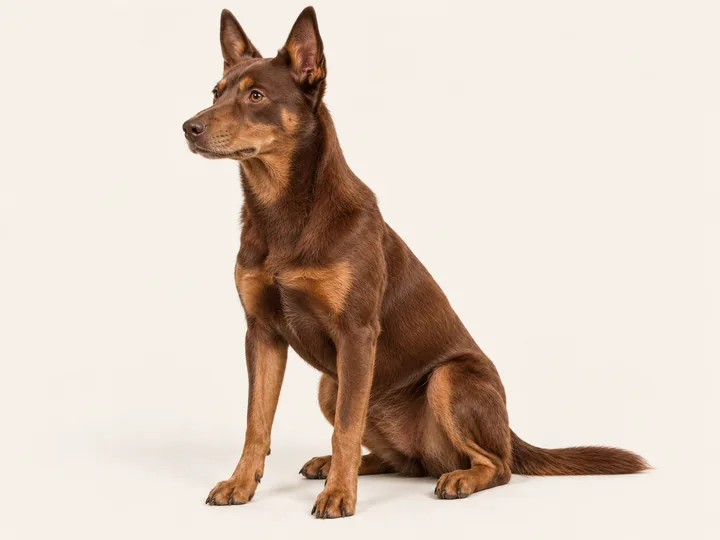
A Kelpie can run the backs of packed sheep and work from before dawn until after dark, and the pet version wants the same day you would give the working one. The breed is affectionate, biddable and clever to an almost unnerving degree — and every one of those virtues turns against a household that leaves it under-worked. More Kelpies are surrendered for being exactly what they are than almost any breed in the country.
At a glance
- Lifespan
- 12–15 years
- Adult weight
- 14–20 kg
- Daily exercise
- 2 hrs plus, and mental work besides
- Trainability
- Exceptional
- Alone time tolerated
- Poor; a bored Kelpie self-employs
- Shedding
- Moderate
- Noise level
- Moderate to high when under-worked
- With children
- Good with its own, may herd them
- With other pets
- Generally good, will work the cat
Colours · 5 listed
Working lines are bred for ability and come in every colour; show lines are more uniform. If you want a pet, the split matters more than the colour.
-
Black
-
Black & tan
-
Red
-
Chocolate
-
Fawn
Right for you if
- You run, ride, mush, or compete, and want a partner who will outlast you.
- Dog sport or real stock work is on the table, not a maybe.
- You enjoy training for its own sake, daily, for the life of the dog.
- Fences are tall, and gaps have been audited by a pessimist.
Wrong for you if
- You are away from home for a standard working day.
- The exercise plan is one walk. A Kelpie warms up somewhere past an hour.
- You want a dog that can be left in a yard. Kelpies climb, and what they cannot climb they dig under.
- A busy household of visitors and chaos, with no quiet job for the dog in it.
What to ask a breeder
- An inherited cerebellar degeneration occurs in the working Kelpie — ataxia, head tremor, a wide stance and a high-stepping gait, with an early form showing before ten weeks of age. Australian researchers have mapped two risk loci, and the later-onset form tracks a single recessive variant.1
- Ask whether the litter or lines have been DNA-tested for cerebellar abiotrophy, and ask to see the result rather than being told it is not in the lines.
- Ask for eye certificates for both parents and whether the lines carry progressive retinal atrophy testing.
- Ask the breeder what happens to their dogs that fail as workers. The honest answer tells you more about the breeder than any certificate.
Sources
- Wade CM, Pan AYH, Taylor RM, Williamson P. Cerebellar abiotrophy in Australian working Kelpies is associated with two major risk loci. Genes 2022. Australia doi:10.3390/genes13101709 PMID 36292596 University of Sydney work on the recessive cerebellar degeneration that occurs in the working Kelpie — ataxia, head tremor, wide stance and a high-stepping gait — mapping two risk loci: an early form showing before ten weeks and a later-onset form inherited as a fully penetrant recessive.
Every source here was checked, not recalled. Where this page makes a health statement and no source appears against it, that is not an oversight we have hidden — it means the claim is not yet sourced, and the build reports how many are in that state.
Availability, registration and keeping requirements differ from place to place. Check the rules where you live before you commit to any animal — we describe animals, not law.