Breed · Dog
Australian Cattle Dog
Bred in colonial Australia to move cattle over long distances, with dingo in the early mix. Known as the Blue or Red Heeler.
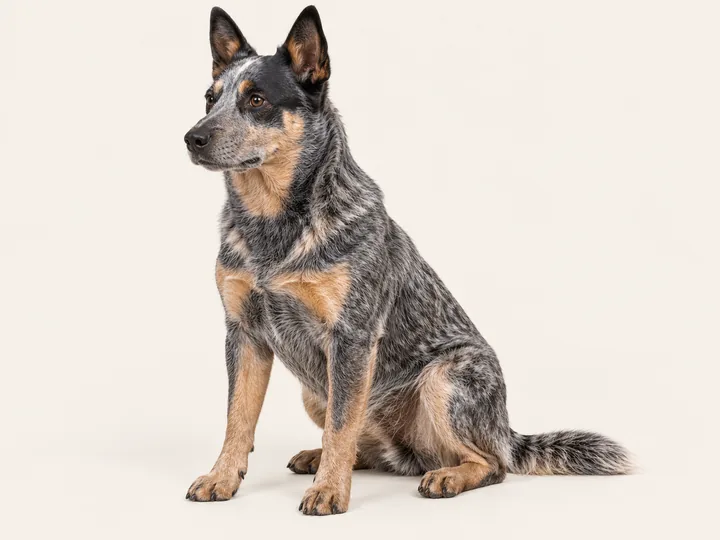
The Cattle Dog was built to bite the heels of livestock all day in heat, and nothing about a suburban backyard has changed its mind. It is intensely loyal to its own people, wary of everyone else, and it does not do idle. Given real work — herding, sport, running, serious training — it is magnificent. Given a courtyard and a walk around the block, it will invent a job, and you will not like the job it invents.
At a glance
- Lifespan
- 12–16 years
- Adult weight
- 15–22 kg
- Daily exercise
- 2 hrs minimum, plus work for the head
- Trainability
- Very high, on its own terms
- Alone time tolerated
- Poor without serious exercise first
- Shedding
- Moderate, heavy in bursts
- Noise level
- Moderate
- With children
- Older children; heels moving ones
- With other pets
- Often fine with its own household, poor with strange animals
Colours · 4 listed
Blue and red are the same dog in different coats. Puppies are born white and colour up over the first weeks.
-
Blue
-
Blue speckled
-
Red
-
Red speckled
Right for you if
- The dog will have genuine daily work: sport, running, herding, or training that never really stops.
- You want one dog, deeply bonded to one household, for well over a decade.
- You are an experienced owner who finds a clever, opinionated dog a pleasure rather than a battle.
- Someone is home most of the day, or the dog comes to work.
Wrong for you if
- The plan is a walk before work and a quiet evening. This breed unravels on that plan.
- Small children and their visiting friends are part of daily life — the herding instinct fires at running, shrieking things.
- This is a first dog.
- You want a dog that greets your guests warmly. It will supervise them instead.
What to ask a breeder
- The Cattle Dog is among the breeds at risk of congenital deafness, which is present from birth and testable at litter age by BAER.1 The UK Kennel Club lists BAER hearing testing — including litter screening — for the breed, so the certificates exist to be asked for.2
- The UK Kennel Club also lists eye testing, the prcd-PRA DNA test, and hip and elbow schemes for the breed.2 Ask for results, not summaries.
- Ask what the parents do all day. A Cattle Dog from proven working or sporting lines is a known quantity; a backyard-bred one is the same engine with no steering.
Sources
- Strain GM. Deafness prevalence and pigmentation and gender associations in dog breeds at risk. The Veterinary Journal 2004. International doi:10.1016/s1090-0233(03)00104-7 PMID 14623147 BAER hearing testing across breeds at risk of pigment-associated congenital sensorineural deafness, the Australian Cattle Dog among them; deafness in these breeds is congenital, testable at litter age, and associated with white pigmentation patterns.
- Australian Cattle Dog — breed health and pre-breeding screening. The Royal Kennel Club 2026. Accessed 2026-09-04. United Kingdom The Royal Kennel Club The UK Kennel Club's published screening lists for the breed: best practice is BAER hearing testing (including litter screening), eye testing, prcd-PRA DNA, and hip and elbow schemes.
Every source here was checked, not recalled. Where this page makes a health statement and no source appears against it, that is not an oversight we have hidden — it means the claim is not yet sourced, and the build reports how many are in that state.
Availability, registration and keeping requirements differ from place to place. Check the rules where you live before you commit to any animal — we describe animals, not law.