Breed · Cat
Turkish Angora
An old Turkish breed, preserved deliberately at Ankara Zoo when numbers collapsed.
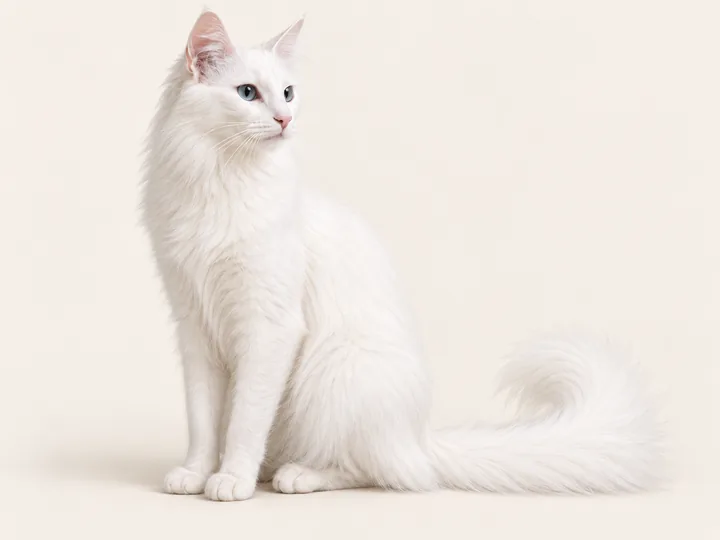
Angoras are fine-boned, silky-coated and much more active than people expect from a longhair — they climb, they supervise, and they involve themselves in everything. The single coat is far less work than a Persian. The one thing to understand before choosing a white one is that white coat colour in cats is linked to deafness, and a one-eared-deaf cat is easy to miss.
At a glance
- Lifespan
- 13–17 years
- Adult weight
- 3–5 kg
- Daily attention
- 60–90 min
- Alone time tolerated
- Reasonably well
- Grooming
- Twice weekly
- Noise level
- Talkative
- With children
- Good
- With other pets
- Generally easy
- Indoor only
- Recommended
Colours · 6 listed
White is the classic but the breed comes in many colours, and the colour you choose has a health question attached to it here.
-
White
-
Black
-
Blue
-
Red
-
Brown Tabby
-
Tortie
Right for you if
- You want an active longhair with a manageable coat.
- You have height and things to climb.
- You will ask for hearing testing if you are choosing a white kitten.
- You want an involved, talkative cat.
Wrong for you if
- You want a placid longhair that sits still.
- You are choosing a white blue-eyed kitten and have not thought about hearing.
- You want a cat that does not climb.
- You will not groom twice a week.
White coats and hearing
- Congenital deafness in cats is linked to the white coat gene, and prevalence is highest in white cats, especially blue-eyed ones. The cochlear blood supply degenerates at three to four weeks of age.1
- Deafness in one ear only is the case that gets missed — such a cat behaves almost normally — and it is properly diagnosed by a brainstem auditory evoked response test rather than by observation.1 Ask whether white kittens have been BAER tested.
- A deaf cat can live a full life indoors. This is a reason to know, and to keep the cat in, rather than a reason to reject a kitten.
Sources
- Strain GM. Congenital deafness and its recognition. Veterinary Clinics of North America: Small Animal Practice 1999; 29(4):895-907. International doi:10.1016/s0195-5616(99)50079-x PMID 10390790 Congenital deafness in cats is tied to the white coat gene, and prevalence is highest in white cats, especially blue-eyed ones. The cochlear blood supply degenerates at three to four weeks of age. One-sided deafness is easy to miss and is diagnosed properly only by a brainstem auditory evoked response test.
Every source here was checked, not recalled. Where this page makes a health statement and no source appears against it, that is not an oversight we have hidden — it means the claim is not yet sourced, and the build reports how many are in that state.
Availability, registration and keeping requirements differ from place to place. Check the rules where you live before you commit to any animal — we describe animals, not law.