Breed · Cat
Tonkinese
A deliberate Burmese-Siamese cross, giving a cat midway between the two in both colour and character.
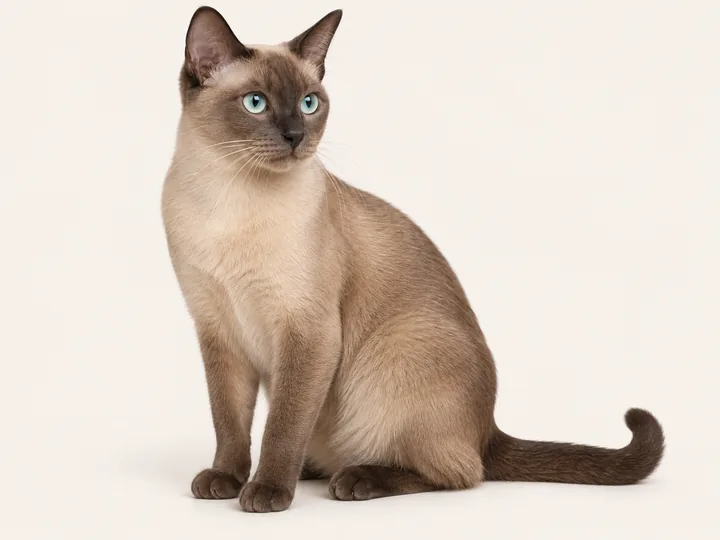
The Tonkinese sits exactly between its parent breeds: less extreme in body than a Siamese, more talkative than a Burmese, and every bit as attached to people as either. This is a cat that will be in the room, on the counter and in the conversation. It also inherits the Burmese side’s specific genetic question, which is worth raising before you buy.
At a glance
- Lifespan
- 13–16 years
- Adult weight
- 3–5.5 kg
- Daily attention
- 90+ min
- Alone time tolerated
- Poorly
- Grooming
- Minimal
- Noise level
- Very vocal
- With children
- Excellent
- With other pets
- Prefers company
- Indoor only
- Recommended
Colours · 6 listed
Mink is the classic — a middle state between Burmese sable and Siamese points — but solid and pointed coats occur in the same litters.
-
Natural Mink
-
Champagne Mink
-
Blue Mink
-
Platinum Mink
-
Seal Point
-
Sable
Right for you if
- Somebody is home most of the day, or you keep two.
- You want a genuinely interactive, talkative cat.
- You want minimal grooming and maximum involvement.
- You will ask about the Burmese head defect test.
Wrong for you if
- You need quiet to work or sleep lightly.
- The house is empty ten hours a day with one cat in it.
- You want an independent cat.
- You are not going to ask about the Burmese-side testing.
The Burmese-side question
- Because of the Burmese ancestry, the Burmese head defect test is offered for Tonkinese. One copy of the variant may shorten the face; two copies cause a craniofacial defect that is incompatible with life.1
- The variant traces to the lineage bred for the extreme head, and roughly 6% of Burmese and related cats carry it.2 Ask for both parents’ results rather than an assurance about the line.
- Two cats is close to the default here. A Tonkinese alone all day is a loud and unhappy animal.
Sources
- Burmese Head Defect — DNA test description. Veterinary Genetics Laboratory, University of California, Davis 2026. Accessed 2026-08-31. International Veterinary Genetics Laboratory, University of California, Davis A commercial DNA test for the ALX1 variant. About 5.9% of Burmese and related cats carry it. A separate midline defect, more common in European lines, has no test — so a clear result does not exclude everything.
- Lyons LA, Erdman CA, Grahn RA, et al. Aristaless-Like Homeobox protein 1 (ALX1) variant associated with craniofacial structure and frontonasal dysplasia in Burmese cats. Developmental Biology 2016; 409(2):451-8. International doi:10.1016/j.ydbio.2015.11.015 PMID 26610632 The lineage bred for the extreme head is named here as the Contemporary Burmese. One copy of the ALX1 variant shapes the head; two copies cause a craniofacial defect incompatible with life. The variant is absent from cats unrelated to that line.
Every source here was checked, not recalled. Where this page makes a health statement and no source appears against it, that is not an oversight we have hidden — it means the claim is not yet sourced, and the build reports how many are in that state.
Availability, registration and keeping requirements differ from place to place. Check the rules where you live before you commit to any animal — we describe animals, not law.