Breed · Cat
Sphynx
From a coatless kitten born in Toronto in 1966, outcrossed to Devon Rex to build the breed.
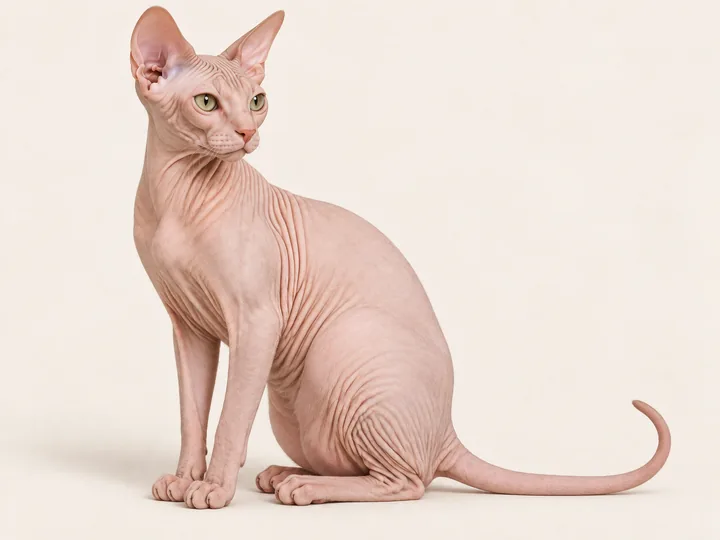
A Sphynx wants to be on you, under the blanket, in the bed, all day. People who love them describe them as barely cat-like in their neediness. Two things get sold wrongly with this breed: they are not low-maintenance because they lack a coat — bare skin needs washing — and they are not hypoallergenic. Cat allergy is a protein in saliva and skin, not fur, and no breed avoids it.
At a glance
- Lifespan
- 12–15 years
- Adult weight
- 3–5 kg
- Daily attention
- 90+ min
- Alone time tolerated
- Poorly
- Grooming
- Weekly bathing
- Noise level
- Talkative
- With children
- Excellent
- With other pets
- Prefers company
- Indoor only
- Essential
Colours · 6 listed
Sphynx are not truly hairless — most carry a fine down — and skin patterns show the colour the cat would have been.
-
Pink
-
Black
-
Blue
-
Cream
-
Bicolour
-
Tortie
Right for you if
- Somebody is home most of the day. This is not a cat to leave.
- You are happy to bathe a cat regularly and keep the house warm.
- You want a genuinely demonstrative, human-obsessed animal.
- You will pay for cardiac scanning before you buy and periodically after.
Wrong for you if
- You are buying one because you think it will not trigger your allergy.
- You want a low-effort cat. No coat means more work, not less.
- The house is cold, or empty all day.
- You are not prepared for heart disease to be a live possibility.
Heart, skin, and the allergy myth
- Hypertrophic cardiomyopathy occurs in this breed and there is no Sphynx DNA test for it. A study sequencing eight candidate genes in affected Sphynx and several other breeds found no causative mutation, which is exactly why echocardiographic screening of breeding cats is the question to ask, not a DNA certificate.1
- The two known feline HCM mutations are one each in the Maine Coon and the Ragdoll.2 A breeder offering "HCM clear" for a Sphynx is offering something that does not exist in the form implied. Ask what was scanned, by whom, and when.
- No cat is hypoallergenic. Ask the breeder directly whether they claim it — the answer tells you a great deal about everything else they will tell you.
- Skin needs regular washing and the ears produce wax heavily. Budget the time weekly, not occasionally.
Sources
- Meurs KM, Norgard MM, Kuan M, Haggstrom J, Kittleson M. Analysis of 8 sarcomeric candidate genes for feline hypertrophic cardiomyopathy mutations in cats with hypertrophic cardiomyopathy. Journal of Veterinary Internal Medicine 2009; 23(4):840-3. International doi:10.1111/j.1939-1676.2009.0341.x PMID 19566849 Sequenced eight candidate genes in affected British Shorthair, Norwegian Forest, Siberian, Sphynx and Maine Coon cats and found no causative mutation — which is why screening, rather than a DNA test, is the question in those breeds. Small numbers.
- Kittleson MD, Meurs KM, Harris SP. The genetic basis of hypertrophic cardiomyopathy in cats and humans. Journal of Veterinary Cardiology 2015; 17 Suppl 1:S53-73. International doi:10.1016/j.jvc.2015.03.001 PMID 26776594 Review confirming the two known feline HCM mutations are one each in the Maine Coon and Ragdoll. It does not establish how common the disease is.
Every source here was checked, not recalled. Where this page makes a health statement and no source appears against it, that is not an oversight we have hidden — it means the claim is not yet sourced, and the build reports how many are in that state.
Availability, registration and keeping requirements differ from place to place. Check the rules where you live before you commit to any animal — we describe animals, not law.