Breed · Cat
Siberian
Russia’s native longhaired cat, recognised internationally only in recent decades.
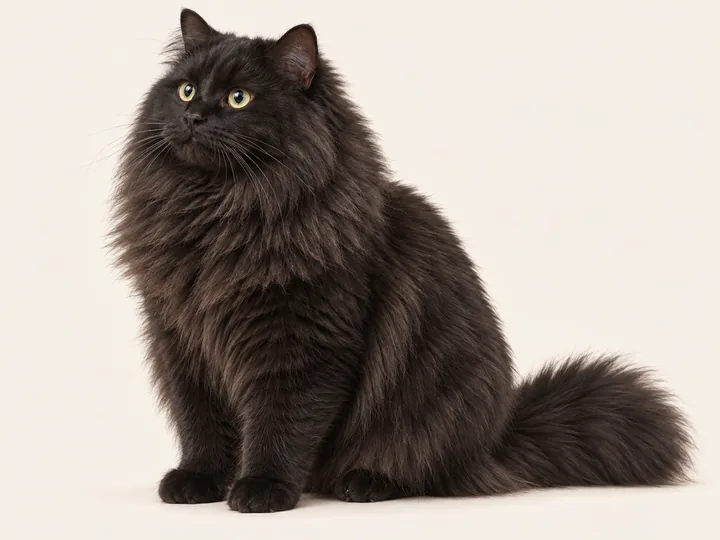
Siberians are large, sociable, remarkably agile for their size, and among the more genuinely affectionate of the big longhairs. They are also the breed most often sold on an allergy claim. That claim outruns the evidence: individual cats vary in how much of the allergen they produce, but no breed is hypoallergenic, and buying one on that basis is how cats end up rehomed.
At a glance
- Lifespan
- 12–16 years
- Adult weight
- 4–8 kg
- Daily attention
- 45–60 min
- Alone time tolerated
- Reasonably well
- Grooming
- Several times a week
- Noise level
- Quiet
- With children
- Excellent
- With other pets
- Generally easy
- Indoor only
- Secure outdoor ideal
Colours · 6 listed
The triple coat is the breed’s defining feature and it changes dramatically between summer and winter.
-
Brown Tabby
-
Silver Tabby
-
Black
-
Red
-
White
-
Colourpoint
Right for you if
- You want a large, affectionate cat and will groom it properly.
- You have space and height for a heavy, athletic animal.
- You want a sociable cat that is still fairly self-sufficient.
- You are buying it because you want this cat, not because of an allergy claim.
Wrong for you if
- You or someone in the house is allergic and this is the plan.
- You will not groom several times a week.
- You want a small or low-shedding cat.
- You want a lap cat that stays put.
The allergy claim, and the heart
- No cat breed is hypoallergenic. If anyone in the house is allergic, spend time with adult cats of this breed before committing, and treat any breeder who guarantees a reaction-free cat as unreliable on everything else too.
- Hypertrophic cardiomyopathy occurs in the breed and there is no Siberian DNA test — eight candidate genes were sequenced in affected Siberians and other breeds without finding a causative mutation.1 Ask about cardiologist scanning of the parents.
- The only two feline HCM mutations known are in the Maine Coon and the Ragdoll.2 Any "HCM DNA clear" claim for a Siberian needs explaining.
- The winter coat is a different animal from the summer one. Grooming demand is seasonal and the moult is substantial.
Sources
- Meurs KM, Norgard MM, Kuan M, Haggstrom J, Kittleson M. Analysis of 8 sarcomeric candidate genes for feline hypertrophic cardiomyopathy mutations in cats with hypertrophic cardiomyopathy. Journal of Veterinary Internal Medicine 2009; 23(4):840-3. International doi:10.1111/j.1939-1676.2009.0341.x PMID 19566849 Sequenced eight candidate genes in affected British Shorthair, Norwegian Forest, Siberian, Sphynx and Maine Coon cats and found no causative mutation — which is why screening, rather than a DNA test, is the question in those breeds. Small numbers.
- Kittleson MD, Meurs KM, Harris SP. The genetic basis of hypertrophic cardiomyopathy in cats and humans. Journal of Veterinary Cardiology 2015; 17 Suppl 1:S53-73. International doi:10.1016/j.jvc.2015.03.001 PMID 26776594 Review confirming the two known feline HCM mutations are one each in the Maine Coon and Ragdoll. It does not establish how common the disease is.
Every source here was checked, not recalled. Where this page makes a health statement and no source appears against it, that is not an oversight we have hidden — it means the claim is not yet sourced, and the build reports how many are in that state.
Availability, registration and keeping requirements differ from place to place. Check the rules where you live before you commit to any animal — we describe animals, not law.