Breed · Cat
Siamese
One of the oldest recognised breeds, from Thailand. The modern show type is far more extreme than the older build.
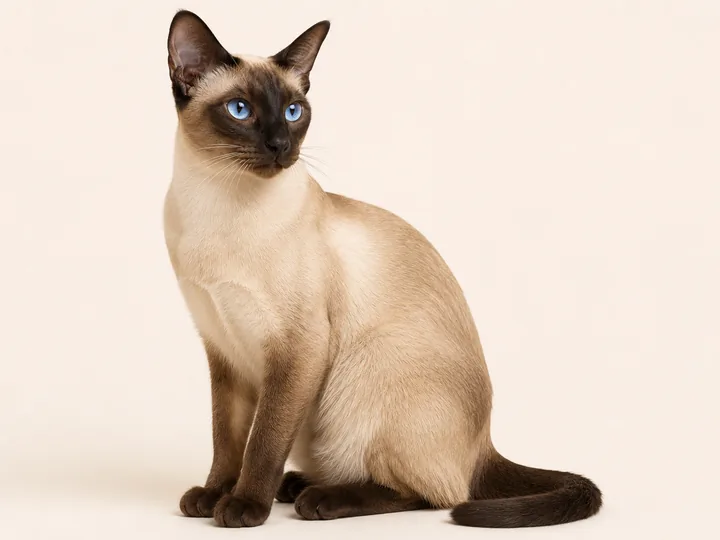
Siamese are the cleverest cats most people will ever live with, and they will use it. They open things. They hold conversations. They object, at volume, in a voice that carries through walls. If you want a cat with opinions, this is the breed. If you want peace, this is a fifteen-year mistake.
At a glance
- Lifespan
- 12–20 years
- Adult weight
- 2.5–5.5 kg
- Daily attention
- 90+ min
- Alone time tolerated
- Poorly
- Grooming
- Minimal
- Noise level
- Very loud
- With children
- Good with older kids
- With other pets
- Prefers company
- Indoor only
- Recommended
Colours · 6 listed
A pointed breed — the body colour deepens with age and with cold, so an older Siamese is noticeably darker than a young one.
-
Seal point
-
Blue point
-
Chocolate point
-
Lilac point
-
Red point
-
Tabby point
Right for you if
- You want a cat that is fully involved in your day.
- Somebody is home, or there is a second cat for company.
- Noise genuinely does not bother you. Be honest here.
- You enjoy an animal that outsmarts you occasionally.
Wrong for you if
- You work from home on calls, or share thin walls with neighbours.
- You want a cat that settles quietly and asks for little.
- Nobody is home during the day and one cat is the plan.
- You have very young children who are startled by noise.
Health and breeding — read this part
- The extreme wedge head that wins shows is not the historical shape of the breed — TICA recognises the Thai, “also called the Old-Style Siamese”, precisely because it preserves the rounder, unexaggerated look the breed had a century ago.1 The older type still exists. Ask breeders which they produce, and why.
- Progressive retinal atrophy and amyloidosis both run in the breed — amyloidosis was found in 6% of Siamese and Oriental cats in one post-mortem series, and appears to be familial.2 There is a DNA test for one form of retinal atrophy, though not one specific to Siamese, and none at all for amyloidosis.3 Ask about both directly.
- Adopting an adult is a genuinely good route into this breed — you hear the voice before you commit to it.
Sources
- Thai — breed standard and description. The International Cat Association (TICA) 2026. Accessed 2026-09-04. International The International Cat Association (TICA) TICA’s breed page for the Thai, “also called the Old-Style Siamese”, recognised to preserve the look of the Siamese as it was over a century ago — a well-balanced cat “without any extremes”, resembling the late 19th and early 20th century Siamese.
- van der Linde-Sipman JS, Niewold TA, Tooten PC, de Neijs-Backer M, Gruys E. Generalized AA-amyloidosis in Siamese and Oriental cats. Veterinary Immunology and Immunopathology 1997; 56(1-2):1-10. International doi:10.1016/s0165-2427(96)05717-0 PMID 9220576 Of 194 Siamese and Oriental cats examined post mortem over seven years, 12 (6.2%) had amyloidosis, affecting liver, spleen and intestines. Pedigree analysis suggested a familial trait, and the amyloid protein in Siamese differed from that in other breeds.
- Siamese — available DNA tests. Veterinary Genetics Laboratory, University of California, Davis 2026. Accessed 2026-08-31. International Veterinary Genetics Laboratory, University of California, Davis The laboratory offers a progressive retinal atrophy test (the rdAc variant) for this breed. No amyloidosis test is offered for any cat breed.
Every source here was checked, not recalled. Where this page makes a health statement and no source appears against it, that is not an oversight we have hidden — it means the claim is not yet sourced, and the build reports how many are in that state.
Availability, registration and keeping requirements differ from place to place. Check the rules where you live before you commit to any animal — we describe animals, not law.