Breed · Cat
Scottish Fold
Descended from one barn cat in Perthshire in 1961 with a spontaneous mutation. Every fold-eared cat alive traces to her.
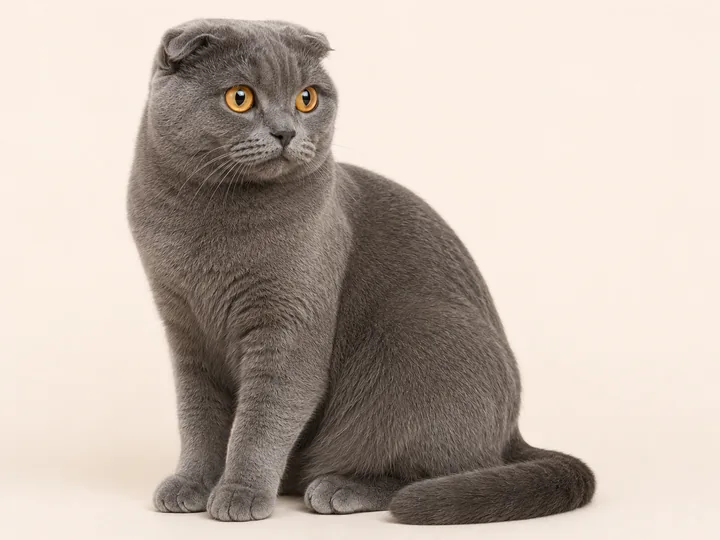
A Scottish Fold is a friendly, easygoing, quiet cat, and that is the part everyone agrees on. The difficulty is the ears. The fold is caused by a change in a gene that builds cartilage, and cartilage is not only in ears — it is in every joint the cat has. That is not an allegation about bad breeders; it is what the fold is. Read the health section before anything else on this page, and then decide.
At a glance
- Lifespan
- 11–15 years
- Adult weight
- 3–6 kg
- Daily attention
- 45–60 min
- Alone time tolerated
- Reasonably well
- Grooming
- Weekly
- Noise level
- Quiet
- With children
- Good
- With other pets
- Generally easy
- Indoor only
- Recommended
Colours · 6 listed
Colour is cosmetic here and changes nothing that matters. Note that roughly half of any Fold litter is born straight-eared — those cats are the same breed and the same temperament, without the variant.
-
Blue
-
Silver Tabby
-
Brown Tabby
-
Cream
-
White
-
Bicolour
Right for you if
- You have read the health section and decided with your eyes open.
- You are adopting an adult Fold who already exists and needs a home.
- You want the temperament and are willing to take a straight-eared littermate instead.
- You can budget for lifelong joint care as a likely cost, not a remote one.
Wrong for you if
- You want the ears and would rather not think about what causes them.
- You are buying from anyone who mates two fold-eared cats together.
- You want a cat you can reasonably expect to be sound at ten.
- A breeder tells you the joint problem was bred out. It cannot be — it is the same gene as the ears.
Health — read this before the rest
- The folded ear is caused by a variant in TRPV4, a gene that governs how cartilage develops. The same change that folds the ear acts on cartilage and bone elsewhere in the body, which is why this is a whole-cat matter and not a cosmetic one.1
- How badly a single-copy cat is affected is genuinely contested, and you deserve both halves. An Australian series in 1999 found every Fold examined had some degree of osteochondrodysplasia and advised against breeding fold-eared cats at all.2 A blinded, genotyped study in 2021 found folds still scored worse than straight-eared controls but far more mildly than that, and criticised the earlier work for studying cats who came to attention because they were already lame.1 Both are worth knowing; neither says the gene is harmless.
- Two copies is not contested. Cats inheriting the variant from both parents develop severe disease, which is why fold-to-fold matings are the line no one defends.1 Ask what the other parent was, and do not accept a vague answer.
- Watch for reluctance to jump, a stiff short-stepping gait, thickened ankles or a tail that will not flex. Those are the signs described in affected cats, and they can start in kittens.2
- If it is the round face and the sweet nature you want, ask the breeder for a straight-eared kitten from the same litter. Same cat, same lines, without the variant.
Sources
- Rorden C, Griswold MC, Moses N, et al. Radiographical survey of osteochondrodysplasia in Scottish Fold cats caused by the TRPV4 gene variant. Human Genetics 2021; 140(11):1525-1534. International doi:10.1007/s00439-021-02337-5 PMID 34406467 The folded ear is caused by a single variant in TRPV4, a gene that governs cartilage development, so the same change that folds the ear acts on cartilage and bone elsewhere. Cats with two copies develop severe disease. In this blinded, genotyped study of 22 cats, the ten folded-eared cats were all carriers of one copy and scored worse than straight-eared controls, but with much milder signs than earlier work reported. The authors describe the question of whether folds should be bred at all as a genuinely open debate.
- Malik R, Allan GS, Howlett CR, Thompson DE, James G, McWhirter C, Kendall K. Osteochondrodysplasia in Scottish Fold cats. Australian Veterinary Journal 1999; 77(2):85-92. Australia doi:10.1111/j.1751-0813.1999.tb11672.x PMID 10078353 Ten Scottish Folds, aged five months to eleven years, with lameness, reluctance to jump, a stiff gait, misshapen distal limbs and short inflexible tails. The authors attribute it to defective cartilage maturation and conclude that all Scottish Fold cats suffered osteochondrodysplasia to some degree, and that the best solution is to avoid breeding fold-eared cats. Every affected cat with known pedigree came from a fold mated to a straight-eared cat — the mating that was supposed to be safe.
Every source here was checked, not recalled. Where this page makes a health statement and no source appears against it, that is not an oversight we have hidden — it means the claim is not yet sourced, and the build reports how many are in that state.
Availability, registration and keeping requirements differ from place to place. Check the rules where you live before you commit to any animal — we describe animals, not law.