Breed · Cat
Russian Blue
A naturally occurring blue shorthair from northern Russia, established in Britain in the late 1800s.
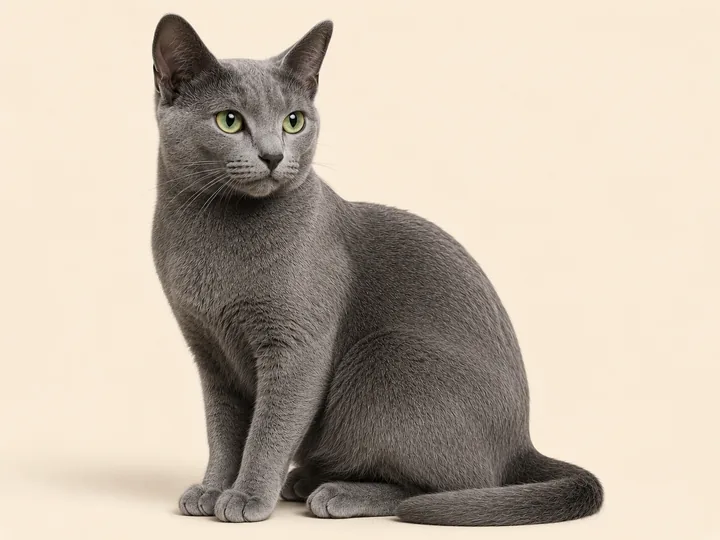
A Russian Blue will disappear when the doorbell goes and reappear the moment your guests leave. They bond closely and quietly with their own household and find upheaval genuinely difficult — new furniture, new routines, new people. Gentle, clean, undemanding, and a poor choice for a chaotic house. The plush double coat is the other signature and it needs very little.
At a glance
- Lifespan
- 13–18 years
- Adult weight
- 3–5.5 kg
- Daily attention
- 30–45 min
- Alone time tolerated
- Well
- Grooming
- Weekly
- Noise level
- Quiet
- With children
- Good with calm children
- With other pets
- Slow introductions
- Indoor only
- Recommended
Colours · 1 listed
One colour: blue with silver-tipped guard hairs, and green eyes that develop over the first year.
-
Blue
Right for you if
- Your household is calm and fairly predictable.
- You want a devoted cat that is not a show-off.
- You are out at work and want a cat that copes alone.
- You want very low grooming.
Wrong for you if
- Your house is loud, busy and full of visitors.
- You want a cat that greets guests.
- You move house or change routine constantly.
- You want an obviously affectionate cat from day one — this takes weeks.
What to ask about
- No breed DNA test for hypertrophic cardiomyopathy exists here — the two known mutations are Maine Coon and Ragdoll — so ask about cardiologist scanning of the parents.1
- Ask how the kittens were raised and how much handling they had. In a reserved breed, early socialisation makes more difference than in most.
- They are prone to putting on weight indoors and the dense coat hides it. Weigh rather than eyeball.
Sources
- Kittleson MD, Meurs KM, Harris SP. The genetic basis of hypertrophic cardiomyopathy in cats and humans. Journal of Veterinary Cardiology 2015; 17 Suppl 1:S53-73. International doi:10.1016/j.jvc.2015.03.001 PMID 26776594 Review confirming the two known feline HCM mutations are one each in the Maine Coon and Ragdoll. It does not establish how common the disease is.
Every source here was checked, not recalled. Where this page makes a health statement and no source appears against it, that is not an oversight we have hidden — it means the claim is not yet sourced, and the build reports how many are in that state.
Availability, registration and keeping requirements differ from place to place. Check the rules where you live before you commit to any animal — we describe animals, not law.