Breed · Cat
Ragdoll
Bred in California in the 1960s for size, coat and an unusually placid temperament.
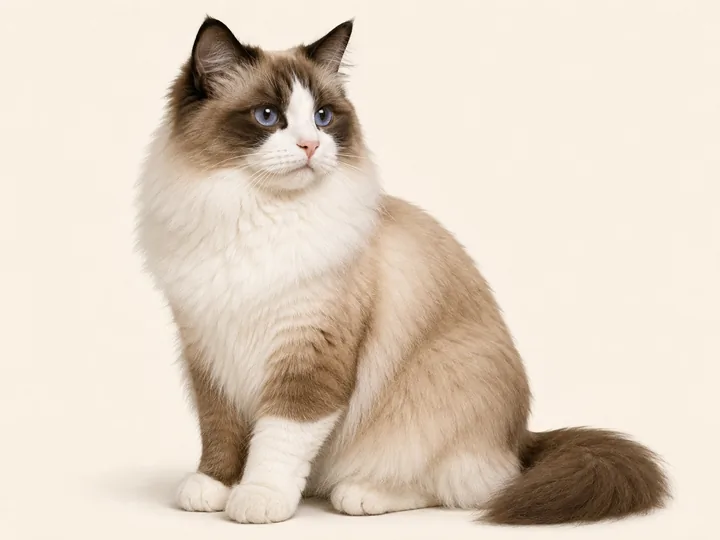
The Ragdoll is the cat people mean when they say they want a cat that behaves like a dog. Big, soft, slow to take offence, and genuinely tolerant of being carried about by children. The trade-offs are a semi-long coat that will not groom itself and a temperament with no self-preservation instinct whatsoever.
At a glance
- Lifespan
- 12–17 years
- Adult weight
- 4.5–9 kg
- Daily attention
- 45–60 min
- Alone time tolerated
- Moderate
- Grooming
- 2–3× weekly
- Noise level
- Quiet
- With children
- Excellent
- With other pets
- Very tolerant
- Indoor only
- Essential
Colours · 6 listed
Ragdolls are a pointed breed — colour develops with age, so kittens look nothing like the adult cat you are choosing.
-
Seal point
-
Blue point
-
Chocolate point
-
Lilac point
-
Mitted
-
Bicolour
Right for you if
- You want a large, affectionate, low-drama cat.
- You have young children and want the odds on your side.
- You will actually do the grooming, weekly, for fifteen years.
- The cat will live entirely indoors or in a cat run.
Wrong for you if
- You want a cat with outdoor access. This breed will walk up to anything.
- Grooming sounds like something you will get around to.
- You want a cat that is active and interactive rather than restful.
- You are buying on price — the coat and the size both cost money.
Health and breeding — read this part
- Hypertrophic cardiomyopathy is the breed's serious problem. There is a DNA test for one Ragdoll-specific mutation12; ask for the parents' results and for evidence of cardiac scanning, which is not the same thing.
- The size is real. A nine-kilo cat needs a litter tray most retailers do not stock.
- Beware anyone selling a Ragdoll cheaply. The health testing is the expensive part, and it is the part that gets skipped.
Sources
- Meurs KM, Norgard MM, Ederer MM, Hendrix KP, Kittleson MD. A substitution mutation in the myosin binding protein C gene in ragdoll hypertrophic cardiomyopathy. Genomics 2007; 90(2):261-4. International doi:10.1016/j.ygeno.2007.04.007 PMID 17521870 Identifies the Ragdoll-specific MYBPC3 mutation causing hypertrophic cardiomyopathy — a different mutation from the Maine Coon's, in an unrelated breed.
- Kittleson MD, Meurs KM, Harris SP. The genetic basis of hypertrophic cardiomyopathy in cats and humans. Journal of Veterinary Cardiology 2015; 17 Suppl 1:S53-73. International doi:10.1016/j.jvc.2015.03.001 PMID 26776594 Review confirming the two known feline HCM mutations are one each in the Maine Coon and Ragdoll. It does not establish how common the disease is.
Every source here was checked, not recalled. Where this page makes a health statement and no source appears against it, that is not an oversight we have hidden — it means the claim is not yet sourced, and the build reports how many are in that state.
Availability, registration and keeping requirements differ from place to place. Check the rules where you live before you commit to any animal — we describe animals, not law.