Breed · Cat
Persian
In Britain and America since the 1800s. The flat face is a twentieth-century show trend, not the historical cat.
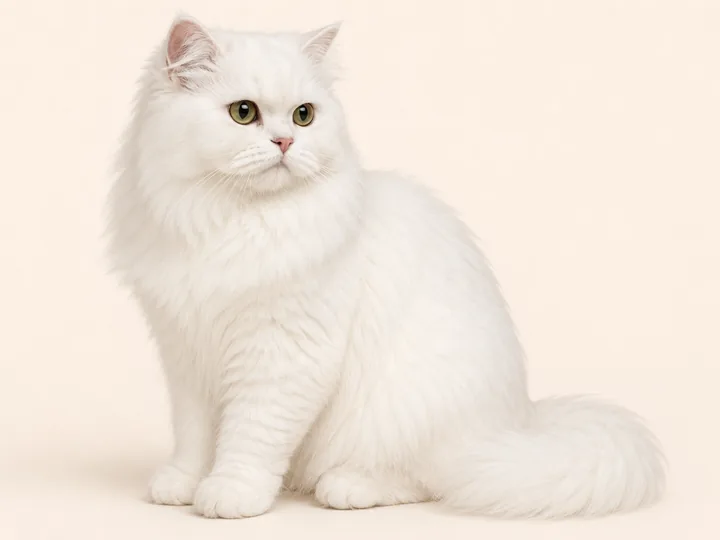
Persians are genuinely placid — they will sit where you put them and ask very little. The problem is not the temperament, it is the face. Breeding for flatness has moved the eyes, the nose and the teeth, and how far it has gone varies enormously from cat to cat. That variation is your lever: a Persian with a visible nose is a different animal to own than one without.
At a glance
- Lifespan
- 12–17 years
- Adult weight
- 3–5.5 kg
- Daily attention
- 30 min
- Alone time tolerated
- Well
- Grooming
- Daily, no exceptions
- Noise level
- Quiet
- With children
- Good
- With other pets
- Generally easy
- Indoor only
- Recommended
Colours · 7 listed
Persians come in almost every colour, and none of it matters. The measurement that matters is the face, not the coat.
-
White
-
Blue
-
Cream
-
Black
-
Red
-
Chinchilla
-
Colourpoint
Right for you if
- You want a calm indoor cat and are home enough to groom it daily.
- You will choose the least extreme face in the litter and say why.
- You can afford eye and dental care as routine rather than exceptional.
- You want a cat that will genuinely sit with you rather than on the door frame.
Wrong for you if
- Daily grooming sounds like something you will get to.
- You want the flattest face you can find.
- Nobody in the house can commit to wiping eyes most days.
- You want a cat that grooms itself adequately. This one cannot.
The face is the health question
- Flatness is measurable and it has consequences. In a CT study of 69 Persians, the flatter the face, the more of the eyeball sat outside the bony socket meant to protect it, the lower the bony nasal opening, and the more the upper premolars were pushed out of line.1
- The same study is the reason to keep looking rather than give up on the breed: the range among Persians was wide, and the least extreme cats overlapped with ordinary domestic shorthairs.1 A nose you can see is not a cosmetic preference.
- Polycystic kidney disease is the other one, and it is the most common inherited disease in cats, particularly in Persians. There is a DNA test and it tracks the disease reliably.2 Ask for the parents’ results.
- Ask to watch the cat breathe and eat while you are there, with its mouth shut and unstressed. A breeder who is proud of the line will not mind you looking.
Sources
- Sieslack J, Farke D, Failing K, Kramer M, Schmidt MJ. Correlation of brachycephaly grade with level of exophthalmos, reduced airway passages and degree of dental malalignment in Persian cats. PLoS ONE 2021; 16(7):e0254420. International doi:10.1371/journal.pone.0254420 PMID 34288937 CT study of 69 Persians against 10 domestic shorthairs. The flatter the face, the more of the eyeball sits outside the bony socket that should protect it, the lower the bony nasal opening, and the more the upper premolars are displaced. Importantly the range among Persians is wide, and the least extreme individuals overlap with ordinary domestic shorthairs.
- Helps C, Tasker S, Harley R. Correlation of the feline PKD1 genetic mutation with cases of PKD diagnosed by pathological examination. Experimental and Molecular Pathology 2007; 83(2):264-8. International doi:10.1016/j.yexmp.2007.04.002 PMID 17553488 All 25 cats carrying the PKD1 mutation had renal cysts, supporting the test as reliable. Its cats were Persians, domestic short and longhairs and a Bengal — not British Shorthairs. Two wild-type cats had cysts, so other mutations may exist.
Every source here was checked, not recalled. Where this page makes a health statement and no source appears against it, that is not an oversight we have hidden — it means the claim is not yet sourced, and the build reports how many are in that state.
Availability, registration and keeping requirements differ from place to place. Check the rules where you live before you commit to any animal — we describe animals, not law.