Breed · Cat
Ocicat
An accident from an Abyssinian-Siamese breeding programme in the 1960s. Entirely domestic despite the wild look.
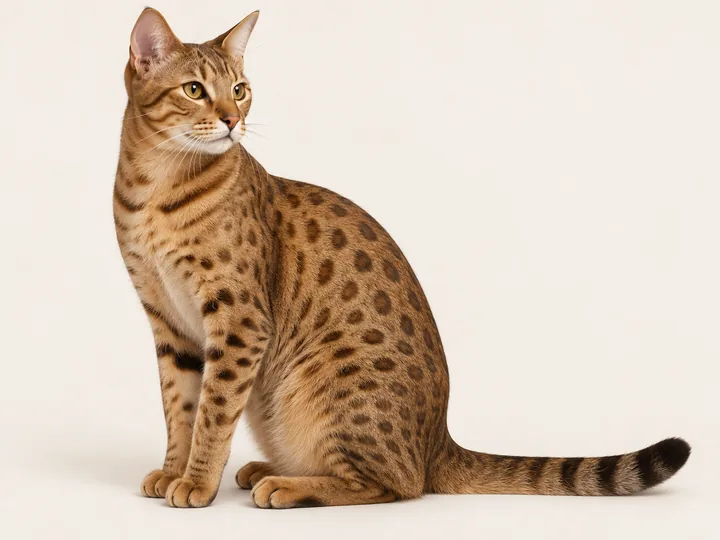
The Ocicat has the spotted coat people want from a wild-looking cat and none of the wild ancestry — it came from Abyssinian, Siamese and American Shorthair crosses, and there is no wild cat anywhere in it. What it does have is Siamese sociability and Abyssinian energy, which means a demanding, talkative, athletic animal that does not do well ignored.
At a glance
- Lifespan
- 12–16 years
- Adult weight
- 4–6.5 kg
- Daily attention
- 90+ min
- Alone time tolerated
- Poorly
- Grooming
- Minimal
- Noise level
- Talkative
- With children
- Excellent
- With other pets
- Prefers company
- Indoor only
- Recommended
Colours · 6 listed
Spots on a ticked ground, in a range of colours. The pattern is the breed; the colour is not.
-
Tawny
-
Chocolate
-
Cinnamon
-
Blue
-
Lavender
-
Silver
Right for you if
- You want the spotted look without any wild ancestry.
- Somebody is home most of the day, or there are two cats.
- You want an athletic, trainable, interactive cat.
- You have height and things to climb.
Wrong for you if
- You want a calm cat.
- The house is empty all day and one cat is the plan.
- You need quiet.
- You wanted the look and assumed the temperament would be ornamental.
What to ask about
- The late-onset form of progressive retinal atrophy has a DNA test and is seen in Abyssinian, Somali and some Ocicat and other breeds.1 Given this breed’s Abyssinian ancestry, ask whether the parents were tested.
- No wild cat was used in creating this breed. If a seller implies otherwise to justify a price, that is a reason to walk away rather than a selling point.
- Ask about heart scanning of the parents — outside the Maine Coon and Ragdoll there is no DNA test to substitute for it.2
Sources
- Abyssinian — available DNA tests. Veterinary Genetics Laboratory, University of California, Davis 2026. Accessed 2026-08-31. International Veterinary Genetics Laboratory, University of California, Davis Three health tests are offered for this breed: two forms of progressive retinal atrophy — a rare early-onset form and a late-onset form also seen in Somali, some Ocicat and other breeds — and pyruvate kinase deficiency, an inherited haemolytic anaemia.
- Kittleson MD, Meurs KM, Harris SP. The genetic basis of hypertrophic cardiomyopathy in cats and humans. Journal of Veterinary Cardiology 2015; 17 Suppl 1:S53-73. International doi:10.1016/j.jvc.2015.03.001 PMID 26776594 Review confirming the two known feline HCM mutations are one each in the Maine Coon and Ragdoll. It does not establish how common the disease is.
Every source here was checked, not recalled. Where this page makes a health statement and no source appears against it, that is not an oversight we have hidden — it means the claim is not yet sourced, and the build reports how many are in that state.
Availability, registration and keeping requirements differ from place to place. Check the rules where you live before you commit to any animal — we describe animals, not law.