Breed · Cat
Norwegian Forest Cat
A Scandinavian farm cat formalised as a breed in the twentieth century. The coat is a working coat.
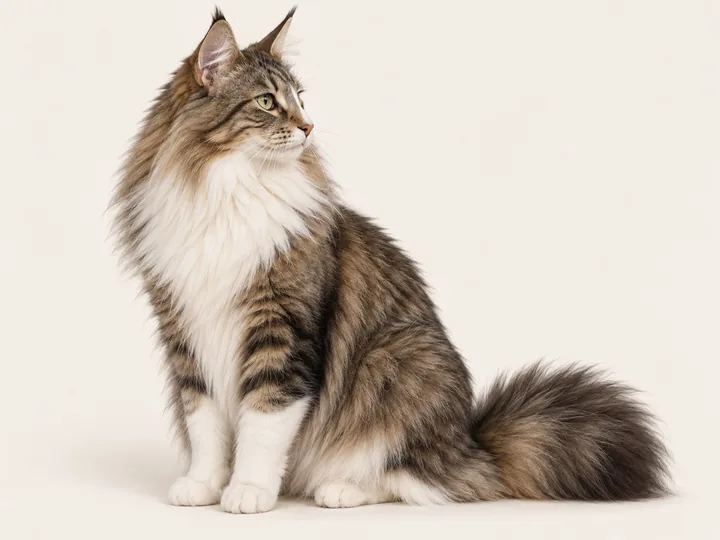
A big, level-headed cat that climbs seriously and does not much care to be carried. The double coat is genuinely weatherproof and genuinely a commitment — it moults heavily twice a year and mats if ignored. Compared with the other big longhairs they are notably self-possessed: affectionate on their own terms, content to be in the room rather than on your lap.
At a glance
- Lifespan
- 12–16 years
- Adult weight
- 4–8 kg
- Daily attention
- 45 min
- Alone time tolerated
- Well
- Grooming
- Several times a week
- Noise level
- Quiet
- With children
- Good
- With other pets
- Generally easy
- Indoor only
- Secure outdoor ideal
Colours · 6 listed
Almost every colour occurs. The coat structure — dense underlayer, water-shedding top — matters far more than the colour.
-
Brown Tabby
-
Black
-
Blue
-
Red
-
White
-
Tabby & White
Right for you if
- You want a large, independent cat that does not demand constant attention.
- You will groom several times a week and daily when it moults.
- You can give it height, and ideally secure outdoor access.
- You want a calm household cat rather than a lap cat.
Wrong for you if
- You want a cat that will sit on you.
- Grooming a heavy double coat sounds like a chore you will skip.
- You have no vertical space at all.
- You want a small cat. These are not.
What to ask about
- Hypertrophic cardiomyopathy occurs in this breed, and a study that sequenced eight candidate genes in affected Norwegian Forest cats and several other breeds found no causative mutation.1 So the question for a breeder is cardiac scanning, not a DNA certificate.
- Ask what the line is tested for and how recently the parents were scanned. "The line is clear" without dates is not an answer.
- This coat mats at the ruff and the trousers first. If you are going to let it go anywhere, do not let it go there.
- They climb high and heavily. Check what is above head height before you bring one home.
Sources
- Meurs KM, Norgard MM, Kuan M, Haggstrom J, Kittleson M. Analysis of 8 sarcomeric candidate genes for feline hypertrophic cardiomyopathy mutations in cats with hypertrophic cardiomyopathy. Journal of Veterinary Internal Medicine 2009; 23(4):840-3. International doi:10.1111/j.1939-1676.2009.0341.x PMID 19566849 Sequenced eight candidate genes in affected British Shorthair, Norwegian Forest, Siberian, Sphynx and Maine Coon cats and found no causative mutation — which is why screening, rather than a DNA test, is the question in those breeds. Small numbers.
Every source here was checked, not recalled. Where this page makes a health statement and no source appears against it, that is not an oversight we have hidden — it means the claim is not yet sourced, and the build reports how many are in that state.
Availability, registration and keeping requirements differ from place to place. Check the rules where you live before you commit to any animal — we describe animals, not law.