Breed · Cat
Maine Coon
A North American farm cat formalised as a breed in the 19th century; the size is genuine, not selective breeding for novelty.
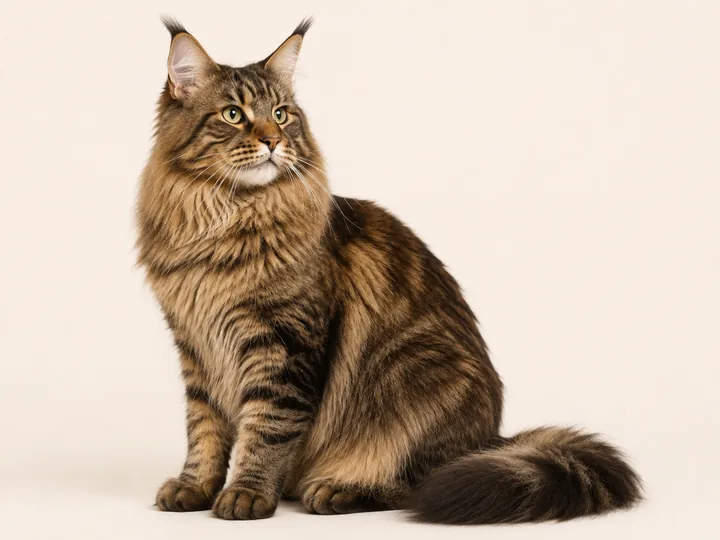
Maine Coons are the largest cats most people will keep, and everything scales with that: the food bill, the litter tray, the cat flap, the vet's dosages. They are gentle, sociable and slow to mature — three to four years to full size. The coat is the daily commitment; a neglected Maine Coon coat mats to the skin and has to be clipped under sedation.
At a glance
- Lifespan
- 10–15 years
- Adult weight
- 4.5–11 kg
- Daily attention
- 45–60 min
- Alone time tolerated
- Moderate
- Grooming
- 3–4× weekly
- Noise level
- Chirps and trills
- With children
- Excellent
- With other pets
- Very good
- Indoor only
- Recommended
Colours · 7 listed
One of the most colour-diverse breeds there is — brown tabby is the classic, but the recognised list runs long.
-
Brown tabby
-
Silver tabby
-
Black
-
Blue
-
Cream
-
Tortie
-
Bicolour
Right for you if
- You have the space, and a household that likes a big presence in it.
- You will groom several times a week without fail.
- You want a sociable cat that is calm rather than demanding.
- The budget accounts for a cat that eats like a small dog.
Wrong for you if
- You live somewhere genuinely small.
- Grooming is aspirational rather than scheduled.
- You want a cat that reaches adulthood quickly.
- Vet bills scaled to an eleven-kilo animal would be a problem.
Health and breeding — read this part
- There is a Maine Coon-specific HCM mutation with a DNA test1, and hip dysplasia is real in a cat this size. Ask for both, plus cardiac scanning of the parents.
- Spinal muscular atrophy also has a DNA test, and carriers show nothing themselves.2 Three tests, all cheap, all routinely skipped by volume breeders.
- Be sceptical of anyone advertising record-breaking size. We treat breeding for an extreme as a warning sign rather than an achievement, whatever the extreme is.
Sources
- Kittleson MD, Meurs KM, Harris SP. The genetic basis of hypertrophic cardiomyopathy in cats and humans. Journal of Veterinary Cardiology 2015; 17 Suppl 1:S53-73. International doi:10.1016/j.jvc.2015.03.001 PMID 26776594 Review confirming the two known feline HCM mutations are one each in the Maine Coon and Ragdoll. It does not establish how common the disease is.
- Spinal Muscular Atrophy (SMA) in Maine Coon Cats — DNA test description. Veterinary Genetics Laboratory, University of California, Davis 2026. Accessed 2026-08-31. International Veterinary Genetics Laboratory, University of California, Davis A commercial DNA test for Maine Coon spinal muscular atrophy. It is recessive, so carriers show nothing themselves. The condition is disabling but neither painful nor fatal, and affected cats can live comfortably indoors.
Every source here was checked, not recalled. Where this page makes a health statement and no source appears against it, that is not an oversight we have hidden — it means the claim is not yet sourced, and the build reports how many are in that state.
Availability, registration and keeping requirements differ from place to place. Check the rules where you live before you commit to any animal — we describe animals, not law.