Breed · Cat
Japanese Bobtail
A Japanese breed of great antiquity, with a short pom-pom tail that is a long-established natural trait.
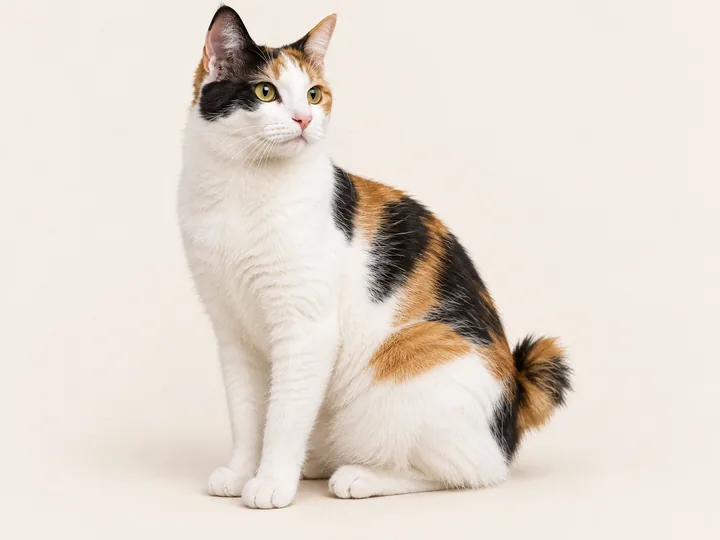
Bobtails are busy, chatty, strongly people-oriented cats that fetch, ride on shoulders and generally behave less like furniture than most breeds. The tail is a tight pom-pom, unique to each cat, and it is worth being clear that this is a different trait from Manx taillessness — a distinction that matters if you have read the Manx page and arrived here worried.
At a glance
- Lifespan
- 13–17 years
- Adult weight
- 3–5 kg
- Daily attention
- 60–90 min
- Alone time tolerated
- Reasonably well
- Grooming
- Weekly
- Noise level
- Talkative
- With children
- Excellent
- With other pets
- Generally easy
- Indoor only
- Recommended
Colours · 6 listed
The tail is a short kinked pom-pom rather than an absence, and no two are alike. Calico — mi-ke — is the classic.
-
Mi-ke (Calico)
-
White
-
Black
-
Red
-
Tortie
-
Black & White
Right for you if
- You want an interactive, talkative cat that plays games with you.
- You want an athletic cat and have height for it.
- You want the bobtail look without the Manx spinal question.
- Somebody is around for a decent part of the day.
Wrong for you if
- You want a quiet, low-involvement cat.
- You want a cat that will not climb anything.
- You are hoping for a lap ornament.
- You wanted a tailless cat — this is a short kinked tail, not an absence.
A different tail from the Manx
- The genetic work that identified T-gene mutations behind short tails found a shared mutant allele in the Manx, the American Bobtail and the Pixie-Bob — and did not place this breed in that group.1 The Manx spinal picture should not be assumed here.
- That is a reason not to worry by default, not a reason not to ask. A breeder should still be able to tell you about mobility and continence in their line.
- Ask about heart scanning of the parents, since no breed DNA test for hypertrophic cardiomyopathy exists outside two breeds.2
Sources
- Buckingham KJ, McMillin MJ, Brassil MM, et al. Multiple mutant T alleles cause haploinsufficiency of Brachyury and short tails in Manx cats. Mammalian Genome 2013; 24(9-10):400-8. International doi:10.1007/s00335-013-9471-1 PMID 23949773 The Manx tail comes from mutations in the T gene, which encodes Brachyury, a protein central to how the spine forms. 95% of short-tailed Manx carried one. One of these alleles is shared with the American Bobtail and the Pixie-Bob.
- Kittleson MD, Meurs KM, Harris SP. The genetic basis of hypertrophic cardiomyopathy in cats and humans. Journal of Veterinary Cardiology 2015; 17 Suppl 1:S53-73. International doi:10.1016/j.jvc.2015.03.001 PMID 26776594 Review confirming the two known feline HCM mutations are one each in the Maine Coon and Ragdoll. It does not establish how common the disease is.
Every source here was checked, not recalled. Where this page makes a health statement and no source appears against it, that is not an oversight we have hidden — it means the claim is not yet sourced, and the build reports how many are in that state.
Availability, registration and keeping requirements differ from place to place. Check the rules where you live before you commit to any animal — we describe animals, not law.