Breed · Cat
Exotic Shorthair
A Persian in a short coat, created by crossing Persians with American Shorthairs in the 1950s.
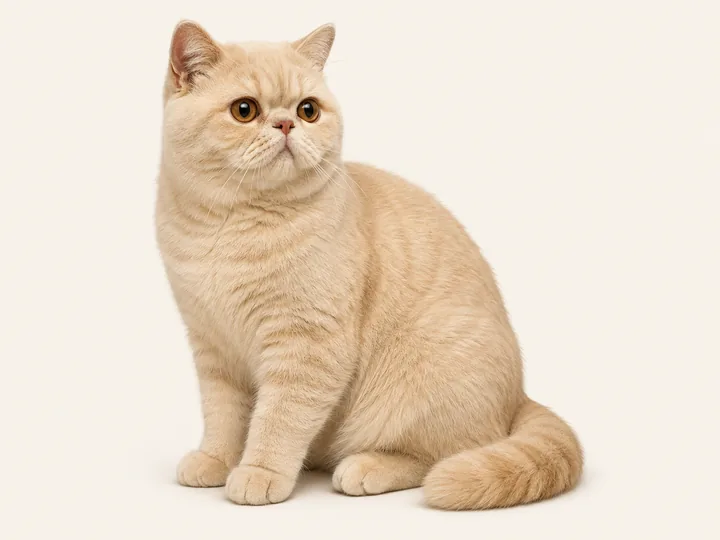
The Exotic exists to solve one problem — the Persian coat — and it solves it well. What it does not solve is the head. This is a Persian skull under a short coat, so everything on the Persian page about faces applies here unchanged. If you came looking for an easier Persian, you have found one; just do not mistake easier grooming for a healthier animal.
At a glance
- Lifespan
- 12–15 years
- Adult weight
- 3–6 kg
- Daily attention
- 30 min
- Alone time tolerated
- Well
- Grooming
- Weekly
- Noise level
- Quiet
- With children
- Good
- With other pets
- Generally easy
- Indoor only
- Recommended
Colours · 6 listed
As with the Persian, the colour is the least interesting thing about the cat in front of you.
-
Blue
-
Cream
-
Brown Tabby
-
Black
-
White
-
Bicolour
Right for you if
- You want the Persian temperament and cannot commit to daily grooming.
- You will judge the face by the same standard you would judge a Persian.
- You want a quiet cat that is happy indoors.
- You are prepared for the same eye and dental costs.
Wrong for you if
- You believe the short coat makes it a healthier cat. It does not change the skull.
- You want the flattest face available.
- You want a cat that will play hard and climb high.
- You wanted low-maintenance in every sense — the eyes still need attention.
Same skull as the Persian
- This is a Persian head. The CT work on Persian skulls found that increasing flatness meant more of the eyeball outside its bony socket, a lower bony nasal opening and more displaced upper premolars — and it applies to this breed for the same reason the face does.1
- That study also found a wide range, with the least extreme individuals overlapping ordinary domestic shorthairs.1 Choose from the moderate end and you have chosen well.
- Polycystic kidney disease runs in the Persian family and the DNA test is reliable — every cat carrying the mutation in one series had the kidney cysts to go with it.2
- The short coat still mats behind the ears and under the arms. Weekly, not never.
Sources
- Sieslack J, Farke D, Failing K, Kramer M, Schmidt MJ. Correlation of brachycephaly grade with level of exophthalmos, reduced airway passages and degree of dental malalignment in Persian cats. PLoS ONE 2021; 16(7):e0254420. International doi:10.1371/journal.pone.0254420 PMID 34288937 CT study of 69 Persians against 10 domestic shorthairs. The flatter the face, the more of the eyeball sits outside the bony socket that should protect it, the lower the bony nasal opening, and the more the upper premolars are displaced. Importantly the range among Persians is wide, and the least extreme individuals overlap with ordinary domestic shorthairs.
- Helps C, Tasker S, Harley R. Correlation of the feline PKD1 genetic mutation with cases of PKD diagnosed by pathological examination. Experimental and Molecular Pathology 2007; 83(2):264-8. International doi:10.1016/j.yexmp.2007.04.002 PMID 17553488 All 25 cats carrying the PKD1 mutation had renal cysts, supporting the test as reliable. Its cats were Persians, domestic short and longhairs and a Bengal — not British Shorthairs. Two wild-type cats had cysts, so other mutations may exist.
Every source here was checked, not recalled. Where this page makes a health statement and no source appears against it, that is not an oversight we have hidden — it means the claim is not yet sourced, and the build reports how many are in that state.
Availability, registration and keeping requirements differ from place to place. Check the rules where you live before you commit to any animal — we describe animals, not law.