Breed · Cat
Devon Rex
From a curly-coated kitten found in Devon in 1959. A separate mutation from the Cornish Rex, found a decade earlier and a county away.
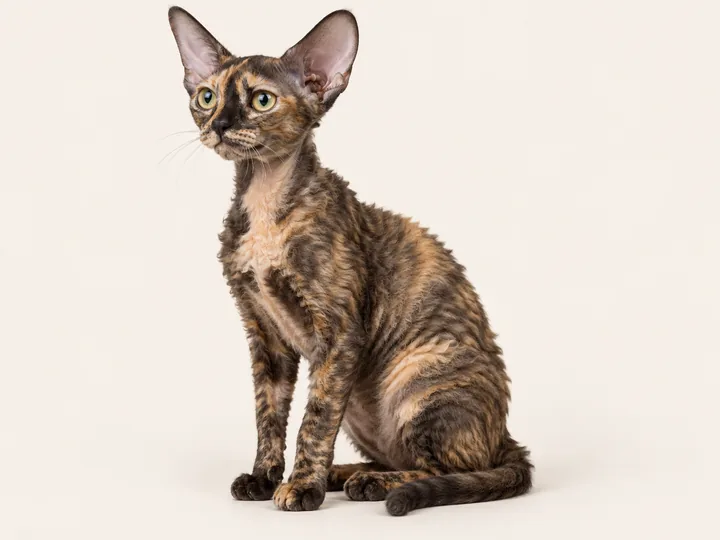
Devon Rex are odd-looking and know it. They are small, warm to the touch, extremely people-focused, and they climb on shoulders rather than laps. The coat is thin and sheds little, which gets miscast as hypoallergenic — it is not, and no cat is. They feel the cold, they eat like something twice the size, and they are miserable left alone.
At a glance
- Lifespan
- 12–16 years
- Adult weight
- 2.5–4.5 kg
- Daily attention
- 90+ min
- Alone time tolerated
- Poorly
- Grooming
- Minimal, handle gently
- Noise level
- Talkative
- With children
- Excellent
- With other pets
- Prefers company
- Indoor only
- Recommended
Colours · 6 listed
The coat is soft, short and irregular, and thin in places. Bald patches are common in kittens and usually fill in.
-
Black
-
Blue
-
White
-
Cream
-
Brown Tabby
-
Tortie
Right for you if
- You want a cat that treats you as furniture and company both.
- Somebody is home, or you are taking two.
- The house is warm. They seek heat constantly.
- You want minimal shedding and accept it is not an allergy solution.
Wrong for you if
- You are buying it for allergies. That is not how cat allergy works.
- You want an independent cat.
- Your home is cold or draughty.
- You groom firmly — this coat and skin need a light hand.
What to ask about
- The thin coat is not an allergy fix. Cat allergy comes from a protein in saliva and skin rather than from fur, so a cat that sheds less still produces it. Ask the breeder whether they claim otherwise.
- Ask about heart screening in the line. Hypertrophic cardiomyopathy has known mutations in only two breeds, the Maine Coon and the Ragdoll, so for every other breed the meaningful question is whether breeding cats are scanned by a cardiologist.1
- They lose heat quickly for their size. Warm sleeping places are a welfare matter here, not an indulgence.
- Ask to see the kitten eat. They have big appetites, and a Devon that is off its food is worth a vet call sooner than most.
Sources
- Kittleson MD, Meurs KM, Harris SP. The genetic basis of hypertrophic cardiomyopathy in cats and humans. Journal of Veterinary Cardiology 2015; 17 Suppl 1:S53-73. International doi:10.1016/j.jvc.2015.03.001 PMID 26776594 Review confirming the two known feline HCM mutations are one each in the Maine Coon and Ragdoll. It does not establish how common the disease is.
Every source here was checked, not recalled. Where this page makes a health statement and no source appears against it, that is not an oversight we have hidden — it means the claim is not yet sourced, and the build reports how many are in that state.
Availability, registration and keeping requirements differ from place to place. Check the rules where you live before you commit to any animal — we describe animals, not law.