Breed · Cat
Cornish Rex
From a curly kitten born on a Cornish farm in 1950. A different mutation from the Devon Rex.
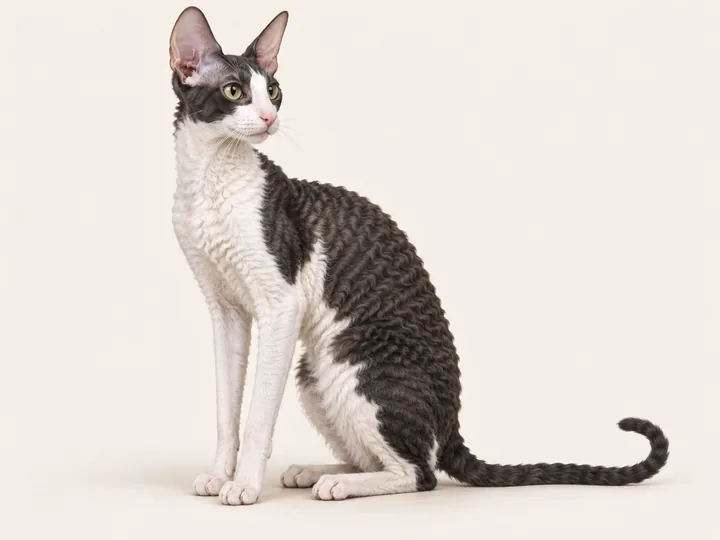
A Cornish Rex is a greyhound in cat form — arched back, long legs, fine bones, and a coat of soft waves with no guard hairs at all. They run and jump far more than they lounge, and they stay kittenish well into old age. Like the Devon they are warm-seeking, sociable and frequently mis-sold as hypoallergenic, which is not a thing that exists.
At a glance
- Lifespan
- 12–16 years
- Adult weight
- 2.5–4.5 kg
- Daily attention
- 60–90 min
- Alone time tolerated
- Poorly
- Grooming
- Minimal, handle gently
- Noise level
- Talkative
- With children
- Excellent
- With other pets
- Prefers company
- Indoor only
- Recommended
Colours · 6 listed
The waves come from a coat with no guard hairs, which is why it feels like suede and why the cat feels warm.
-
White
-
Blue
-
Black
-
Red
-
Cream
-
Bicolour
Right for you if
- You want an athletic, playful cat well past kittenhood.
- The house is warm and there is somewhere high to run.
- Somebody is home, or there are two cats.
- You want very little shedding and understand that is not the same as hypoallergenic.
Wrong for you if
- You are buying for allergies.
- You want a calm cat that settles early.
- Your home is cold.
- You want something sturdy — these are fine-boned cats.
What to ask about
- As with every breed except the Maine Coon and the Ragdoll, there is no breed DNA test for hypertrophic cardiomyopathy, so ask whether the breeding cats are scanned rather than asking for a certificate.1
- No cat is hypoallergenic, and a fine coat does not change that. The allergen is in saliva and skin.
- A coat with no guard hairs offers little insulation. Warmth is a real requirement.
- Fine bones and enormous enthusiasm is a combination worth cat-proofing for.
Sources
- Kittleson MD, Meurs KM, Harris SP. The genetic basis of hypertrophic cardiomyopathy in cats and humans. Journal of Veterinary Cardiology 2015; 17 Suppl 1:S53-73. International doi:10.1016/j.jvc.2015.03.001 PMID 26776594 Review confirming the two known feline HCM mutations are one each in the Maine Coon and Ragdoll. It does not establish how common the disease is.
Every source here was checked, not recalled. Where this page makes a health statement and no source appears against it, that is not an oversight we have hidden — it means the claim is not yet sourced, and the build reports how many are in that state.
Availability, registration and keeping requirements differ from place to place. Check the rules where you live before you commit to any animal — we describe animals, not law.