Breed · Cat
Burmese
Developed from a single cat brought from Burma to the United States in the 1930s. Two recognised body types diverged after that.
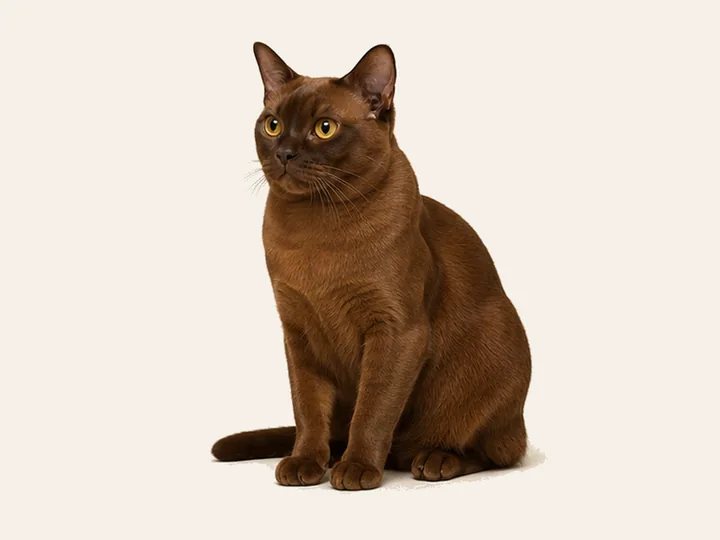
A Burmese does not treat you as furniture. It treats you as its person, and it will spend fourteen years making that clear — on your keyboard, under the doona, in the shower doorway. People who love them love them completely. People who wanted a cat that leaves them alone should read almost any other page on this site.
At a glance
- Lifespan
- 15–18 years
- Adult weight
- 3.5–6 kg
- Daily attention
- 90+ min
- Alone time tolerated
- Poorly
- Grooming
- Minimal
- Noise level
- Talkative
- With children
- Excellent
- With other pets
- Prefers company
- Indoor only
- Recommended
Colours · 7 listed
Colour is cosmetic in this breed — it changes nothing about temperament, cost or care. Registries differ on which are recognised.
-
Brown
-
Blue
-
Chocolate
-
Lilac
-
Red
-
Cream
-
Tortie
Right for you if
- Somebody is home most of the day, or you can keep two.
- You want a cat that is genuinely involved in the household.
- You have children, and want a cat that will tolerate them.
- You are happy to keep it indoors or in a secured yard.
Wrong for you if
- The house is empty ten hours a day and one cat is the plan.
- You need silence to work, or you sleep lightly.
- You wanted an independent cat that entertains itself.
- You are not prepared to answer the same door twenty times.
Health and breeding — read this part
- The two body types are not cosmetic trivia. The lineage bred for the extreme head — the Contemporary Burmese — carries a craniofacial defect that is fatal in kittens inheriting two copies, and about 6% of Burmese and related cats carry it.12 There is a DNA test. Ask any breeder directly which type they breed and what they test for.
- Ask to see the parents, in the room they live in. A breeder who will not show you that is telling you something.
- Diabetes is over-represented in the breed.34 Budget for it as a real possibility, not a horror story.
Sources
- Lyons LA, Erdman CA, Grahn RA, et al. Aristaless-Like Homeobox protein 1 (ALX1) variant associated with craniofacial structure and frontonasal dysplasia in Burmese cats. Developmental Biology 2016; 409(2):451-8. International doi:10.1016/j.ydbio.2015.11.015 PMID 26610632 The lineage bred for the extreme head is named here as the Contemporary Burmese. One copy of the ALX1 variant shapes the head; two copies cause a craniofacial defect incompatible with life. The variant is absent from cats unrelated to that line.
- Burmese Head Defect — DNA test description. Veterinary Genetics Laboratory, University of California, Davis 2026. Accessed 2026-08-31. International Veterinary Genetics Laboratory, University of California, Davis A commercial DNA test for the ALX1 variant. About 5.9% of Burmese and related cats carry it. A separate midline defect, more common in European lines, has no test — so a clear result does not exclude everything.
- Lederer R, Rand JS, Jonsson NN, Hughes IP, Morton JM. Frequency of feline diabetes mellitus and breed predisposition in domestic cats in Australia. The Veterinary Journal 2007; 179(2):254-8. Australia doi:10.1016/j.tvjl.2007.09.019 PMID 18155627 Australian data: 12,576 cats in Brisbane over five years. Burmese had 22.4 diabetes cases per 1000 against 7.6 in domestic short and longhaired cats.
- Ohlund M, Fall T, Strom Holst B, Hansson-Hamlin H, Bonnett B, Egenvall A. Incidence of diabetes mellitus in insured Swedish cats in relation to age, breed and sex. Journal of Veterinary Internal Medicine 2015; 29(5):1342-7. Sweden doi:10.1111/jvim.13584 PMID 26179258 A cohort of 504,688 insured Swedish cats. Confirms the Burmese is at increased risk of diabetes, independently of the Australian data.
Every source here was checked, not recalled. Where this page makes a health statement and no source appears against it, that is not an oversight we have hidden — it means the claim is not yet sourced, and the build reports how many are in that state.
Availability, registration and keeping requirements differ from place to place. Check the rules where you live before you commit to any animal — we describe animals, not law.