Breed · Cat
Birman
A pointed longhair with white feet, rebuilt in France after the Second World War from very few cats.
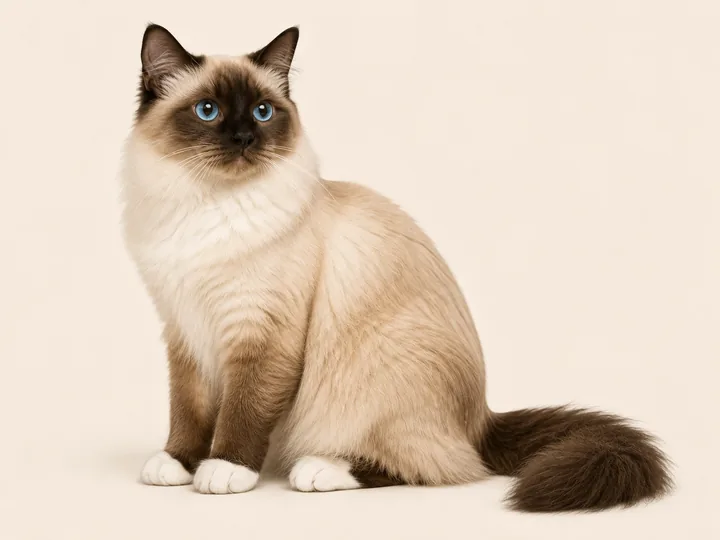
Birmans are the pointed cat for people who cannot live with a Siamese. Same colouring, entirely different volume: they are soft-voiced, undemanding and famously good with children and other animals. The coat is single, so it is far less work than a Persian, and the white gloves are the breed’s signature. They want company but do not shout for it.
At a glance
- Lifespan
- 13–16 years
- Adult weight
- 4–6 kg
- Daily attention
- 45 min
- Alone time tolerated
- Reasonably well
- Grooming
- Twice weekly
- Noise level
- Quiet
- With children
- Excellent
- With other pets
- Generally easy
- Indoor only
- Recommended
Colours · 6 listed
Points in several colours, always with white gloves on the feet. The gloving is what breeders are selecting for and it is purely cosmetic.
-
Seal Point
-
Blue Point
-
Chocolate Point
-
Lilac Point
-
Red Point
-
Tortie Point
Right for you if
- You want a pointed cat without the Siamese voice.
- You have children or other pets and want something tolerant.
- You will comb twice a week.
- You want affection without constant demand.
Wrong for you if
- You want a highly active, athletic cat.
- You will not groom at all.
- You want a cat that is happy entirely alone for long days.
- You expected the Siamese personality with a longer coat — that is the Balinese.
What to ask about
- The breed was rebuilt from a very small number of cats after the Second World War, so ask the breeder directly about the inbreeding coefficient of the pairing and what they do to keep it down. A breeder who has never considered the question is the answer.
- There is no breed DNA test for hypertrophic cardiomyopathy — the two known feline mutations are Maine Coon and Ragdoll only — so cardiac scanning of the parents is the relevant question.1
- The single coat mats far less than it looks like it should, but the ruff and trousers still need attention.
Sources
- Kittleson MD, Meurs KM, Harris SP. The genetic basis of hypertrophic cardiomyopathy in cats and humans. Journal of Veterinary Cardiology 2015; 17 Suppl 1:S53-73. International doi:10.1016/j.jvc.2015.03.001 PMID 26776594 Review confirming the two known feline HCM mutations are one each in the Maine Coon and Ragdoll. It does not establish how common the disease is.
Every source here was checked, not recalled. Where this page makes a health statement and no source appears against it, that is not an oversight we have hidden — it means the claim is not yet sourced, and the build reports how many are in that state.
Availability, registration and keeping requirements differ from place to place. Check the rules where you live before you commit to any animal — we describe animals, not law.