Breed · Cat
Bengal
Developed from crosses between domestic cats and the Asian leopard cat, several generations back. Registry Bengals are domestic cats.
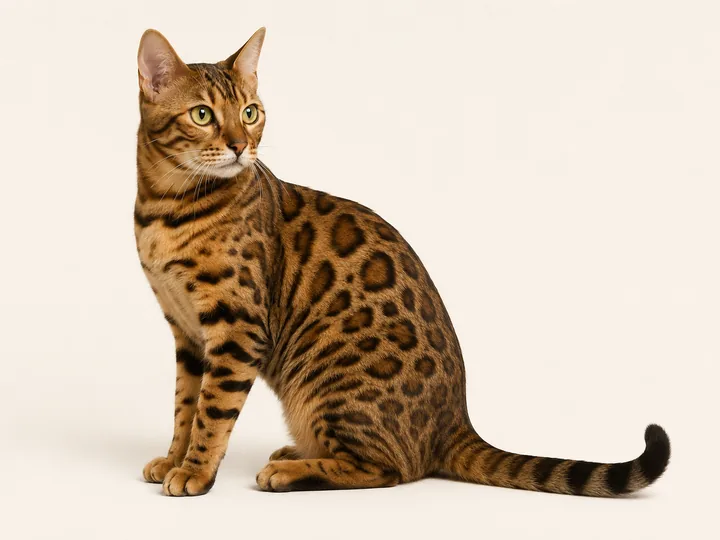
Bengals are demanding in a way that surprises people who bought the coat. They are strong, extremely active, often water-obsessed, and vocal about being under-occupied. In the right house they are magnificent. In a small flat with an absent owner they become destructive and loud, and they end up in rescue. The wild ancestry is many generations back — a registered Bengal is a domestic cat — but the energy is not a myth.
At a glance
- Lifespan
- 12–16 years
- Adult weight
- 4–7 kg
- Daily attention
- 90+ min
- Alone time tolerated
- Poorly
- Grooming
- Minimal
- Noise level
- Loud
- With children
- Good with older
- With other pets
- Needs careful matching
- Indoor only
- Recommended
Colours · 6 listed
Spotted and marbled are the two patterns. Neither changes the cat’s needs, and both are sold at prices that suggest otherwise.
-
Brown Spotted
-
Snow
-
Silver
-
Charcoal
-
Blue
-
Marbled
Right for you if
- You want an animal to interact with daily, not a decoration.
- You have vertical space, and ideally a secure outdoor run.
- You are home a lot, or there are two.
- You will check what generation the cat is and buy well clear of the wild cross.
Wrong for you if
- You bought the look and expected a normal house cat behind it.
- The flat is small and empty all day.
- You want quiet. This breed is not.
- You are being offered an early-generation hybrid. That is not what this site covers.
What to check before you commit
- Progressive retinal atrophy testing is offered for this breed — the late-onset form that appears across several breeds.1 Ask for the parents’ results.
- Ask what generation the cat is. Registered show and pet Bengals are many generations from the original cross and are domestic cats; early-generation hybrids are a different proposition entirely and are outside what this site covers.
- Ask how the kitten was raised and how much handling it had. An under-socialised Bengal is a much harder animal than an under-socialised moggy.
- Plan for water. Many of them play in it, and a Bengal that has decided the sink is a toy will not be talked out of it.
Sources
- Bengal — available DNA tests. Veterinary Genetics Laboratory, University of California, Davis 2026. Accessed 2026-08-31. International Veterinary Genetics Laboratory, University of California, Davis The laboratory lists progressive retinal atrophy testing for the breed — the late-onset form that appears across several breeds.
Every source here was checked, not recalled. Where this page makes a health statement and no source appears against it, that is not an oversight we have hidden — it means the claim is not yet sourced, and the build reports how many are in that state.
Availability, registration and keeping requirements differ from place to place. Check the rules where you live before you commit to any animal — we describe animals, not law.