Breed · Cat
American Shorthair
The working cats that came to North America on ships, formalised as a breed in the early 1900s.
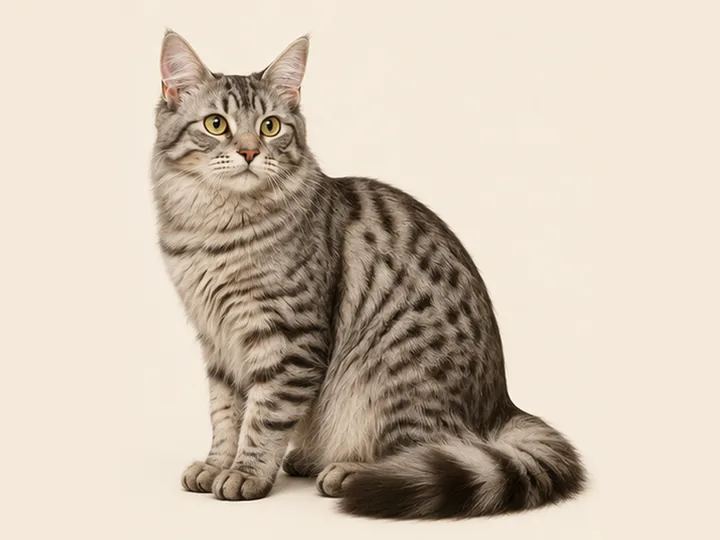
This is a breed whose entire proposition is that nothing about it is exaggerated. Medium everything: size, coat, energy, volume. It was built from working farm cats and never bred toward an extreme, which is why it reads as unremarkable on a chart and lives well in an actual house. If you want a predictable cat with no asterisks, this is close to the point of the breed.
At a glance
- Lifespan
- 13–17 years
- Adult weight
- 4–7 kg
- Daily attention
- 30–45 min
- Alone time tolerated
- Well
- Grooming
- Weekly
- Noise level
- Quiet
- With children
- Excellent
- With other pets
- Generally easy
- Indoor only
- Recommended
Colours · 6 listed
Silver tabby is the one everyone pictures, but the breed comes in most colours and the pattern changes nothing.
-
Silver Tabby
-
Brown Tabby
-
Black
-
Blue
-
Cream
-
Tabby & White
Right for you if
- You want a straightforward cat with no special requirements.
- You have children and want something sturdy and tolerant.
- You are out at work and one cat is the plan.
- You would rather spend money on the cat than on the pedigree.
Wrong for you if
- You want a cat that is dramatic in any direction.
- You want a lap cat that never leaves you.
- You wanted longhair glamour.
- You are choosing on looks alone — a shelter tabby is much the same animal.
What to ask about
- There is no breed DNA test for hypertrophic cardiomyopathy in this breed — the only two known feline mutations are in the Maine Coon and the Ragdoll — so ask whether breeding cats are scanned by a cardiologist.1
- This is a breed where a shelter cat is a genuinely comparable option. Say that to yourself before paying a pedigree price.
- They put on weight quietly and are built solidly enough to hide it. Weigh rather than eyeball.
Sources
- Kittleson MD, Meurs KM, Harris SP. The genetic basis of hypertrophic cardiomyopathy in cats and humans. Journal of Veterinary Cardiology 2015; 17 Suppl 1:S53-73. International doi:10.1016/j.jvc.2015.03.001 PMID 26776594 Review confirming the two known feline HCM mutations are one each in the Maine Coon and Ragdoll. It does not establish how common the disease is.
Every source here was checked, not recalled. Where this page makes a health statement and no source appears against it, that is not an oversight we have hidden — it means the claim is not yet sourced, and the build reports how many are in that state.
Availability, registration and keeping requirements differ from place to place. Check the rules where you live before you commit to any animal — we describe animals, not law.