Breed · Cat
American Curl
From a single stray found in California in 1981 whose ears curled backwards.
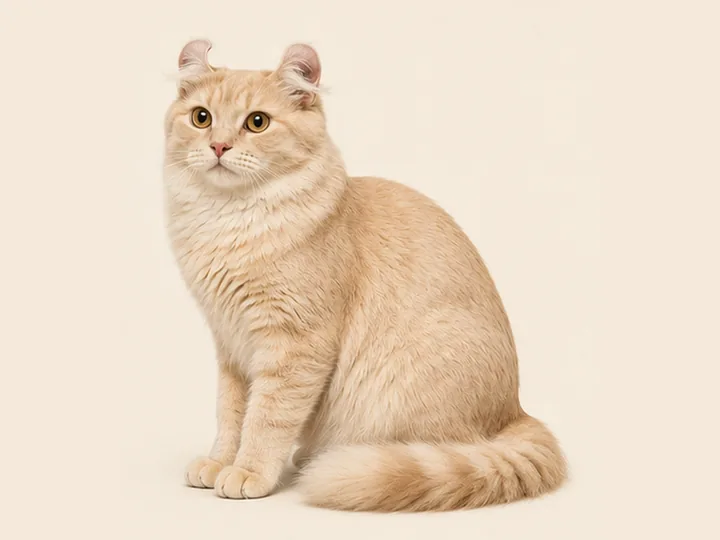
Curls are sociable, even-tempered cats that stay playful late, and the ears are the whole selling point — they curl backwards over the first few months and then stop. Because this site takes the Scottish Fold seriously, it will not wave you past the obvious question here: a breed defined by an ear mutation deserves the same scrutiny. Ask, rather than assuming it is fine or assuming it is not.
At a glance
- Lifespan
- 13–16 years
- Adult weight
- 3–5 kg
- Daily attention
- 45–60 min
- Alone time tolerated
- Reasonably well
- Grooming
- Weekly
- Noise level
- Quiet
- With children
- Excellent
- With other pets
- Generally easy
- Indoor only
- Recommended
Colours · 6 listed
Kittens are born straight-eared and the curl develops over several months. Both coat lengths occur.
-
Brown Tabby
-
Black
-
Blue
-
Cream
-
Silver Tabby
-
Colourpoint
Right for you if
- You want a friendly, adaptable cat that stays playful.
- You will ask the ear question properly rather than taking it on trust.
- You want something unusual-looking without an extreme body shape.
- You are comfortable handling ears gently and often.
Wrong for you if
- You want the ears and would rather not think about the mutation behind them.
- A breeder cannot tell you what the line is screened for.
- You handle roughly — curled ear cartilage should not be forced.
- You want a cat that ignores you.
The ear question, asked honestly
- This site does not claim the curl is equivalent to the Scottish Fold, and does not claim it is harmless either. The Fold is documented: a TRPV4 variant that shapes the ear and acts on cartilage throughout the body.1 No comparable evidence was found for this breed while writing the page, and absence of evidence is not evidence of absence.
- Ask the breeder what the line is screened for and whether any cats have shown joint or mobility problems. Their willingness to engage with that question is itself informative.
- The ears are firm cartilage and should be handled gently. Never force one straight to see how far it goes.
Sources
- Rorden C, Griswold MC, Moses N, et al. Radiographical survey of osteochondrodysplasia in Scottish Fold cats caused by the TRPV4 gene variant. Human Genetics 2021; 140(11):1525-1534. International doi:10.1007/s00439-021-02337-5 PMID 34406467 The folded ear is caused by a single variant in TRPV4, a gene that governs cartilage development, so the same change that folds the ear acts on cartilage and bone elsewhere. Cats with two copies develop severe disease. In this blinded, genotyped study of 22 cats, the ten folded-eared cats were all carriers of one copy and scored worse than straight-eared controls, but with much milder signs than earlier work reported. The authors describe the question of whether folds should be bred at all as a genuinely open debate.
Every source here was checked, not recalled. Where this page makes a health statement and no source appears against it, that is not an oversight we have hidden — it means the claim is not yet sourced, and the build reports how many are in that state.
Availability, registration and keeping requirements differ from place to place. Check the rules where you live before you commit to any animal — we describe animals, not law.