Breed · Cat
American Bobtail
Developed in the United States from the 1960s around a naturally short-tailed cat.
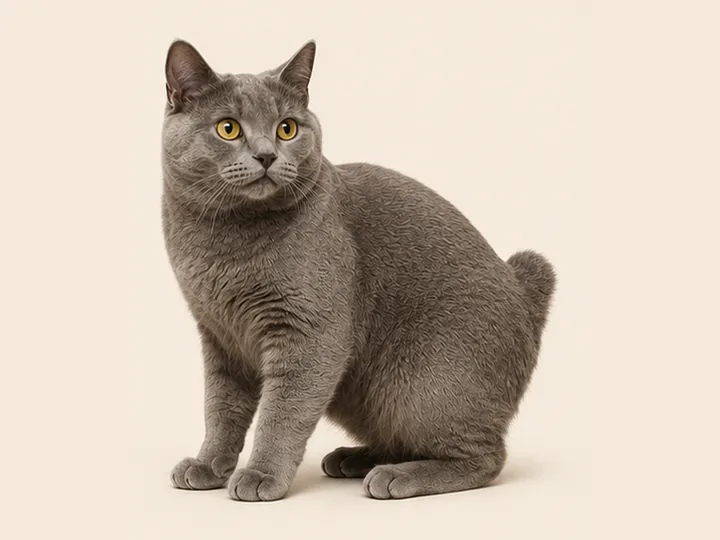
A solid, slow-maturing cat with a reputation for following people around and travelling well. The short tail is the breed’s signature, and it is worth understanding rather than admiring: genetic work on short tails in cats found one mutant allele shared between this breed, the Manx and the Pixie-Bob. That does not make an American Bobtail a Manx, but it does make the spine a fair question.
At a glance
- Lifespan
- 13–17 years
- Adult weight
- 4–7 kg
- Daily attention
- 45 min
- Alone time tolerated
- Reasonably well
- Grooming
- Twice weekly
- Noise level
- Quiet
- With children
- Excellent
- With other pets
- Generally easy
- Indoor only
- Recommended
Colours · 6 listed
Tails vary from very short to about half length, and both coat lengths occur.
-
Brown Tabby
-
Silver Tabby
-
Black
-
Blue
-
Red
-
Tabby & White
Right for you if
- You want a calm, people-oriented cat that is not clingy.
- You are prepared to ask tail-and-spine questions and get real answers.
- You want a sturdy cat that suits a busy household.
- You can wait — they mature slowly.
Wrong for you if
- You want the bobtail look and would rather not ask what causes it.
- A breeder brushes off the question about spinal health.
- You want a small, fine-boned cat.
- You want a cat that is fully grown at a year.
The tail is worth a question
- Genetic work on short-tailed cats identified mutations in the T gene, which encodes a protein central to spine formation, and found one mutant allele shared between the American Bobtail, the Manx and the Pixie-Bob.1
- In the Manx, taillessness travels with a risk of spina bifida, incontinence and hind-limb difficulty, attributed to a disturbance of spinal cord development.2 That evidence is from Manx cats, not this breed — which is exactly why you ask the breeder what they see in their line rather than assuming either way.
- Ask about continence and gait in the line, and watch the kitten move and use a tray before you decide.
Sources
- Buckingham KJ, McMillin MJ, Brassil MM, et al. Multiple mutant T alleles cause haploinsufficiency of Brachyury and short tails in Manx cats. Mammalian Genome 2013; 24(9-10):400-8. International doi:10.1007/s00335-013-9471-1 PMID 23949773 The Manx tail comes from mutations in the T gene, which encodes Brachyury, a protein central to how the spine forms. 95% of short-tailed Manx carried one. One of these alleles is shared with the American Bobtail and the Pixie-Bob.
- Deforest ME, Basrur PK. Malformations and the Manx syndrome in cats. The Canadian Veterinary Journal 1979; 20(11):304-14. International PMID 393376 Breeding study of tailless cats. Taillessness behaves as an autosomal dominant, and the problems that travel with it — spina bifida, urinary and faecal incontinence, and hind-limb difficulty — are attributed to a single disturbance of spinal cord development early in the embryo.
Every source here was checked, not recalled. Where this page makes a health statement and no source appears against it, that is not an oversight we have hidden — it means the claim is not yet sourced, and the build reports how many are in that state.
Availability, registration and keeping requirements differ from place to place. Check the rules where you live before you commit to any animal — we describe animals, not law.