Breed · Cat
Abyssinian
A ticked-coat breed established in Britain in the late 1800s, with a disputed and much-romanticised backstory.
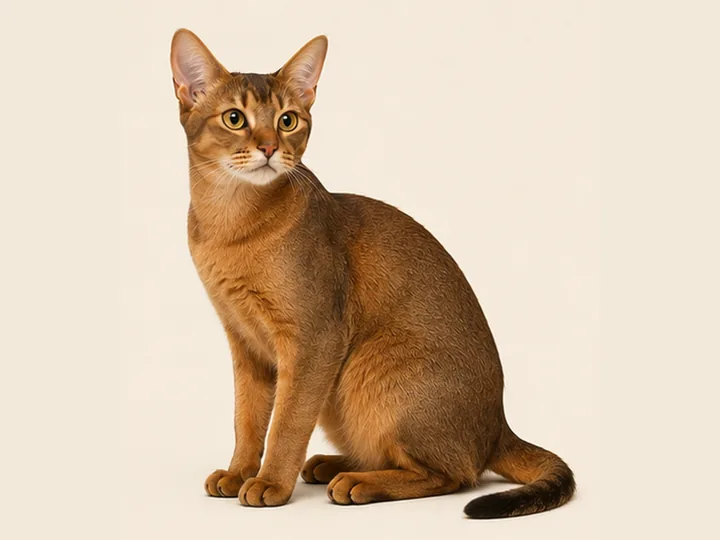
An Abyssinian is the cat that is already on top of the door you just opened. They are agile, endlessly investigative and much less interested in sitting on you than in supervising you. Well suited to people who want a cat present in the room and badly suited to anyone hoping for a quiet ornament. Three inherited conditions have DNA tests, which makes this an easy breed to buy carefully.
At a glance
- Lifespan
- 12–16 years
- Adult weight
- 3–5 kg
- Daily attention
- 60–90 min
- Alone time tolerated
- Poorly
- Grooming
- Minimal
- Noise level
- Talkative
- With children
- Good
- With other pets
- Prefers company
- Indoor only
- Recommended
Colours · 6 listed
The ticked coat is the breed. Each hair is banded, which is why the cat shifts colour as it moves.
-
Ruddy
-
Sorrel
-
Blue
-
Fawn
-
Silver
-
Chocolate
Right for you if
- You want an active, involved cat and have vertical space for it.
- Somebody is home, or there are two cats.
- You want low grooming and high engagement.
- You will ask for three test certificates and know what they are.
Wrong for you if
- You want a lap cat. This is not one.
- The house is empty ten hours a day and one cat is the plan.
- You keep breakable things on high shelves.
- You are not going to check the eye and anaemia tests.
Three tests, all cheap, all worth asking for
- Two forms of progressive retinal atrophy have DNA tests in this breed — a rare early-onset form and a late-onset form shared with Somali and some other breeds — as does pyruvate kinase deficiency, an inherited anaemia.1 All three are carrier-detectable, so a responsible breeding line has documented results rather than reassurance.
- The late-onset retinal form is the one that catches people out: an affected cat sees normally as a kitten and loses sight later, so a bright, apparently perfect kitten tells you nothing about it.1
- Ask for the certificates rather than a verbal assurance, and check the parents’ names actually match the paperwork.
- This breed needs height more than floor space. Plan the room before the cat arrives.
Sources
- Abyssinian — available DNA tests. Veterinary Genetics Laboratory, University of California, Davis 2026. Accessed 2026-08-31. International Veterinary Genetics Laboratory, University of California, Davis Three health tests are offered for this breed: two forms of progressive retinal atrophy — a rare early-onset form and a late-onset form also seen in Somali, some Ocicat and other breeds — and pyruvate kinase deficiency, an inherited haemolytic anaemia.
Every source here was checked, not recalled. Where this page makes a health statement and no source appears against it, that is not an oversight we have hidden — it means the claim is not yet sourced, and the build reports how many are in that state.
Availability, registration and keeping requirements differ from place to place. Check the rules where you live before you commit to any animal — we describe animals, not law.