Species · Bird
Sulphur-crested Cockatoo
Cacatua galerita
The big white cockatoo of eastern and northern Australia — raucous in the wild, magnetic in the lounge room, and the family’s hardest keeping proposition.
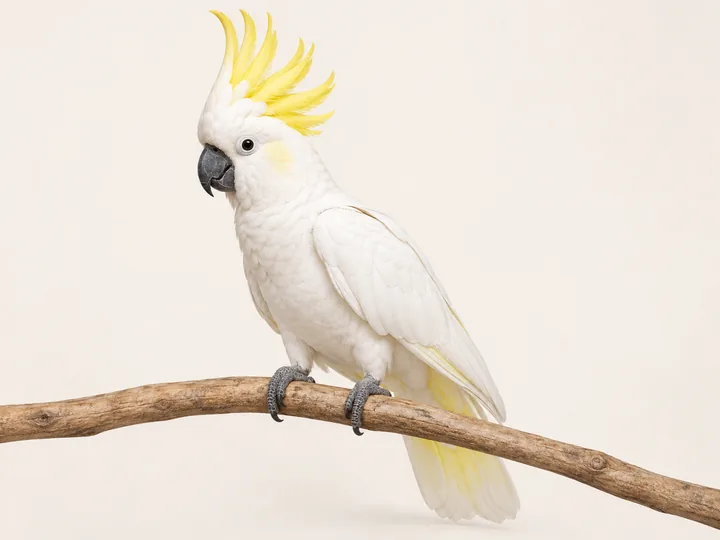
Everything about the sulphur-crested is superlative: the intelligence, the bond, the crest, the volume, the lifespan, and the rehoming statistics. This is a bird that can outlive its owner, out-scream a renovation, and dismantle a window frame on a bored afternoon — and the same animal, properly worked and companioned, is as engaging as anything in aviculture. It is the family’s deep end. The kindest thing this page can do is say plainly: meet several adults first, and let the noise and the decades talk you out of it if they can.
At a glance
- Lifespan
- 40–70+ years
- Adult weight
- 700–1000 g
- Daily attention
- 3+ hrs, and work for the mind
- Alone time tolerated
- Poor — bored sulphurs scream and pluck
- Minimum housing
- Aviary scale, built like it means it
- Noise level
- Extreme — carries suburbs, not rooms
- Feather dust
- Very high — powder down
- With children
- The beak is a bolt cutter; teens up, supervised
- With other pets
- Not with cats; dogs need serious management
Mutations · 1 listed
One glorious wild design. Anything sold as rarer is a different species or a worse idea.
-
White & sulphur
Right for you if
- Detached housing or acreage, and neighbours measured in paddocks.
- You have kept parrots before and know what boredom does to them.
- Succession planning for a pet reads as responsible, not morbid.
- You have stood next to one at full volume and stayed.
Wrong for you if
- Anyone shares a wall with you.
- This would be a first bird.
- The plan involves the bird amusing itself while everyone works.
- You cannot name who takes the bird when you are seventy.
Welfare and sourcing — read this part
- Beak and feather disease is the dominant viral pathogen of parrots in Australia, all psittacines are susceptible,1 and there is no cure.2 For a bird you may keep for half a century, buy only from a breeder who tests and shows the paperwork, and quarantine any newcomer.
- Large parrots do best on about 80% pellets — not the sunflower-heavy mixes still sold by the sack.3 A sulphur on a seed bowl is running a decades-long deficiency experiment on itself.4
- Overheated non-stick cookware releases fumes that kill birds quickly.56
- Native birds are kept under rules that differ by state, and the rules change. Check what applies where you live before you commit.
Sources
- Raidal SR, Sarker S, Peters A. Review of psittacine beak and feather disease and its effect on Australian endangered species. Australian Veterinary Journal 2015. Australia doi:10.1111/avj.12388 PMID 26769072 Charles Sturt University review: since its description in the early 1980s, psittacine beak and feather disease has become recognised as the dominant viral pathogen of psittacine birds in Australia, with all psittacine species susceptible across virus genotypes, and it stands as a listed key threatening process for endangered parrots.
- Skin and Feather Disorders of Pet Birds. MSD Veterinary Manual 2026. Accessed 2026-09-05. International MSD Veterinary Manual Psittacine beak and feather disease affects both wild and pet birds, still occurs in African grey parrots, Eclectus parrots, lovebirds, lorikeets and other Old-World parrots, and has no cure. On feather-destructive behaviour: causes span medical conditions and psychological problems, and malnutrition is likely one of the most common contributing factors.
- Hoppes SM. Management of Pet Birds — Nutrition. MSD Veterinary Manual, professional edition. MSD Veterinary Manual 2026. Accessed 2026-08-31. International MSD Veterinary Manual The two most common causes of malnutrition in companion birds are feeding pure seed, and feeding a bowl the bird can pick through — it eats the seed and leaves the rest. For small birds such as budgerigars and cockatiels the recommendation is 40 to 50% pellets and 30 to 40% seed mix, with vegetables and a little fruit. Large parrots are different, at 80% pellets.
- Hoppes SM. Nutritional Diseases of Pet Birds. MSD Veterinary Manual, professional edition. MSD Veterinary Manual 2026. Accessed 2026-08-31. International MSD Veterinary Manual Much of what ails pet birds starts in malnutrition — liver, kidney, respiratory, bone and reproductive disease. All-seed diets, and even half-seed half-pellet diets, are deficient in vitamin A. Sedentary birds on mainly seed show a high incidence of fatty liver disease and heart failure. Budgerigars on iodine-poor all-seed diets develop goitre, though fortified diets have made that uncommon.
- Wells RE, Slocombe RF. Acute toxicosis of budgerigars (Melopsittacus undulatus) caused by pyrolysis products from heated polytetrafluoroethylene: microscopic study. American Journal of Veterinary Research 1982; 43(7):1243-8. International PMID 7103206 Budgerigars exposed to fumes from heated non-stick coating developed severe necrotising, haemorrhagic pneumonitis. Heated uncoated aluminium was the control.
- Shuster KA, Brock KL, Dysko RC, DiRita VJ, Bergin IL. Polytetrafluoroethylene toxicosis in recently hatched chickens (Gallus domesticus). Comparative Medicine 2012; 62(1):49-52. International PMID 22330651 Mass mortality (92% and 80% of two groups) traced to PTFE-coated heat-lamp bulbs. Birds are highly sensitive to inhaled toxicants.
Every source here was checked, not recalled. Where this page makes a health statement and no source appears against it, that is not an oversight we have hidden — it means the claim is not yet sourced, and the build reports how many are in that state.
Availability, registration and keeping requirements differ from place to place. Check the rules where you live before you commit to any animal — we describe animals, not law.