Species · Bird
Peach-faced Lovebird
Agapornis roseicollis
Small parrot of dry south-west African woodland, named for the pair bond and kept for the colour and cheek.
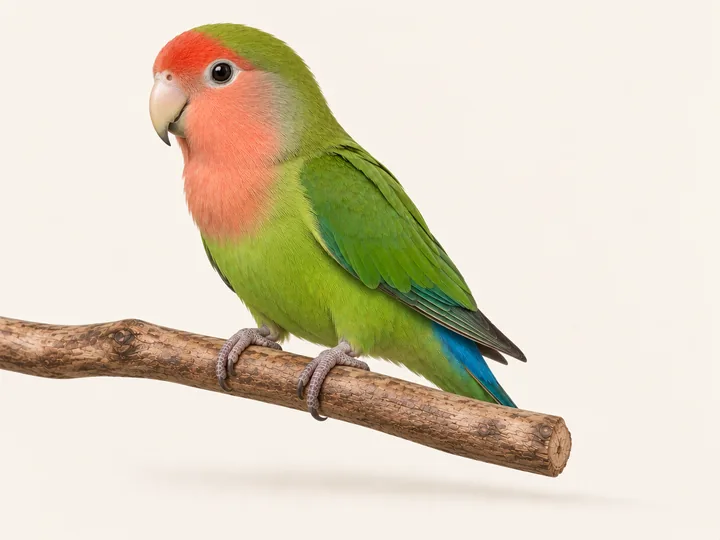
The lovebird myth — that a single bird dies of a broken heart — gets the species kept in pairs by default, and the truth is more useful: a pair bonds to each other and politely files you under furniture, while a single bird with real daily attention bonds to you like a pocket cockatoo. Either is a fine life; choose one on purpose. What nobody warns you about is the attitude: peach-faces are busy, fearless, paper-shredding little bulldozers, and hens in season defend territory like they have read about honour.
At a glance
- Lifespan
- 10–15 years
- Adult weight
- 45–60 g
- Daily attention
- Daily handling for a single; daily oversight for a pair
- Alone time tolerated
- A pair copes; a single alone in a cage does not
- Minimum housing
- Flight cage; bigger than the shop will suggest
- Noise level
- Sharp contact calls, mercifully brief
- Feather dust
- Low to moderate
- With children
- Older, calm children; hens can nip hard
- With other pets
- Not with cats
Mutations · 4 listed
Dozens of mutations from the wild green through lutino and violet. The peach face survives most of them; the attitude survives all of them.
-
Wild green
-
Lutino
-
Dutch blue
-
Violet
Right for you if
- You want either a bonded pair to watch or a single pocket companion to handle — and you know which.
- A busy, confident bird that gets into everything sounds fun.
- Paper, cardboard and willow to destroy are easy to supply.
- Fifteen years is a commitment you can actually see across.
Wrong for you if
- You want the pair AND the cuddles; bonded pairs mostly opt out of you.
- A single bird would sit alone in a cage through working days.
- Nipping would end the relationship; hens have seasons.
- A cat lives in the house.
Welfare and sourcing — read this part
- Psittacine beak and feather disease still occurs in lovebirds among other species, and it has no cure.1 Ask the seller directly whether the aviary tests for it; hesitation is your answer.
- For small birds — the manual names lovebirds — the diet recommendation is 40 to 50% pellets and 30 to 40% seed mix with vegetables and a little fruit; it is seed alone, or a bowl the bird can pick through, that does the damage.2
- Overheated non-stick cookware releases fumes that kill birds quickly.34
- Decide single-or-pair before you buy, not after. Converting a bonded pair into two hand-tame singles is a project that mostly fails; starting right is free.
Sources
- Skin and Feather Disorders of Pet Birds. MSD Veterinary Manual 2026. Accessed 2026-09-05. International MSD Veterinary Manual Psittacine beak and feather disease affects both wild and pet birds, still occurs in African grey parrots, Eclectus parrots, lovebirds, lorikeets and other Old-World parrots, and has no cure. On feather-destructive behaviour: causes span medical conditions and psychological problems, and malnutrition is likely one of the most common contributing factors.
- Hoppes SM. Management of Pet Birds — Nutrition. MSD Veterinary Manual, professional edition. MSD Veterinary Manual 2026. Accessed 2026-08-31. International MSD Veterinary Manual The two most common causes of malnutrition in companion birds are feeding pure seed, and feeding a bowl the bird can pick through — it eats the seed and leaves the rest. For small birds such as budgerigars and cockatiels the recommendation is 40 to 50% pellets and 30 to 40% seed mix, with vegetables and a little fruit. Large parrots are different, at 80% pellets.
- Wells RE, Slocombe RF. Acute toxicosis of budgerigars (Melopsittacus undulatus) caused by pyrolysis products from heated polytetrafluoroethylene: microscopic study. American Journal of Veterinary Research 1982; 43(7):1243-8. International PMID 7103206 Budgerigars exposed to fumes from heated non-stick coating developed severe necrotising, haemorrhagic pneumonitis. Heated uncoated aluminium was the control.
- Shuster KA, Brock KL, Dysko RC, DiRita VJ, Bergin IL. Polytetrafluoroethylene toxicosis in recently hatched chickens (Gallus domesticus). Comparative Medicine 2012; 62(1):49-52. International PMID 22330651 Mass mortality (92% and 80% of two groups) traced to PTFE-coated heat-lamp bulbs. Birds are highly sensitive to inhaled toxicants.
Every source here was checked, not recalled. Where this page makes a health statement and no source appears against it, that is not an oversight we have hidden — it means the claim is not yet sourced, and the build reports how many are in that state.
Availability, registration and keeping requirements differ from place to place. Check the rules where you live before you commit to any animal — we describe animals, not law.