Species · Bird
Pacific Parrotlet
Forpus coelestis
Tiny parrot of dry Pacific-coast scrub in Ecuador and Peru — the smallest commonly kept parrot in the world.
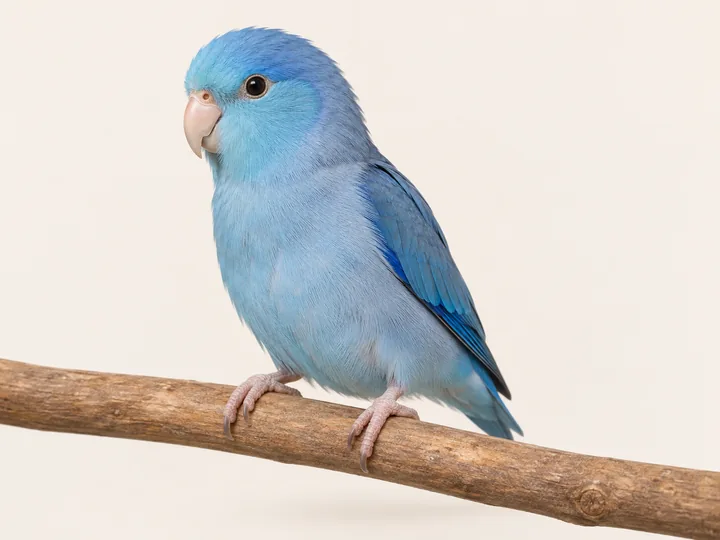
The parrotlet is what you get when nature compresses a macaw’s self-image into a bird the size of your thumb. It is fearless to the point of comedy — and of danger, since it will square up to dogs, cats and vacuum cleaners with total sincerity. Kept singly and handled daily it bonds hard and stays sweet; left in a cage it turns feral surprisingly fast for something so small. Quiet enough for a unit, small enough for a desk, and precisely as much work as a real parrot, because it is one.
At a glance
- Lifespan
- 15–20 years
- Adult weight
- 28–35 g
- Daily attention
- Daily handling, or it wilds off
- Alone time tolerated
- Better singly WITH daily human time than paired and ignored
- Minimum housing
- Flight cage; bar spacing matters at this size
- Noise level
- Low — chatter, not screech
- Feather dust
- Low
- With children
- Too small and too bold for young children
- With other pets
- Genuinely at risk from everything; supervise the bird’s courage
Mutations · 4 listed
Blue, green, yellow and white mutations, all the same militant individual underneath.
-
Green
-
Blue
-
Yellow
-
White
Right for you if
- You want a true parrot bond in the smallest, quietest possible package.
- Ten minutes of handling several times a day is your natural rhythm.
- Space is tight and neighbours are close.
- A pet with a Napoleon complex amuses you.
Wrong for you if
- You want a low-interaction cage bird — an unhandled parrotlet reverts fast.
- Boisterous dogs, cats or young children share the space; the bird will start the fight and lose it.
- You expected volume-matched fragility. It is hardy, but not against a paw.
- Two decades is longer than you were picturing for a thumb-sized bird.
Welfare and sourcing — read this part
- Much of what ails pet birds starts in malnutrition, and a bird this size has no reserves to spend.1 Ask what it was weaned onto, and keep greens and pellets in the mix from day one.
- Overheated non-stick cookware releases fumes that kill birds quickly, and at thirty grams the margin is the thinnest on this site.23
- Buy a hand-raised youngster and keep the handling daily. With this species the tameness is a lease, not a purchase — stop paying and it lapses.
Sources
- Hoppes SM. Nutritional Diseases of Pet Birds. MSD Veterinary Manual, professional edition. MSD Veterinary Manual 2026. Accessed 2026-08-31. International MSD Veterinary Manual Much of what ails pet birds starts in malnutrition — liver, kidney, respiratory, bone and reproductive disease. All-seed diets, and even half-seed half-pellet diets, are deficient in vitamin A. Sedentary birds on mainly seed show a high incidence of fatty liver disease and heart failure. Budgerigars on iodine-poor all-seed diets develop goitre, though fortified diets have made that uncommon.
- Wells RE, Slocombe RF. Acute toxicosis of budgerigars (Melopsittacus undulatus) caused by pyrolysis products from heated polytetrafluoroethylene: microscopic study. American Journal of Veterinary Research 1982; 43(7):1243-8. International PMID 7103206 Budgerigars exposed to fumes from heated non-stick coating developed severe necrotising, haemorrhagic pneumonitis. Heated uncoated aluminium was the control.
- Shuster KA, Brock KL, Dysko RC, DiRita VJ, Bergin IL. Polytetrafluoroethylene toxicosis in recently hatched chickens (Gallus domesticus). Comparative Medicine 2012; 62(1):49-52. International PMID 22330651 Mass mortality (92% and 80% of two groups) traced to PTFE-coated heat-lamp bulbs. Birds are highly sensitive to inhaled toxicants.
Every source here was checked, not recalled. Where this page makes a health statement and no source appears against it, that is not an oversight we have hidden — it means the claim is not yet sourced, and the build reports how many are in that state.
Availability, registration and keeping requirements differ from place to place. Check the rules where you live before you commit to any animal — we describe animals, not law.