Species · Bird
Green-cheeked Conure
Pyrrhura molinae
Small South American conure of Bolivian and Brazilian forest, and the quiet exception in a famously loud family.
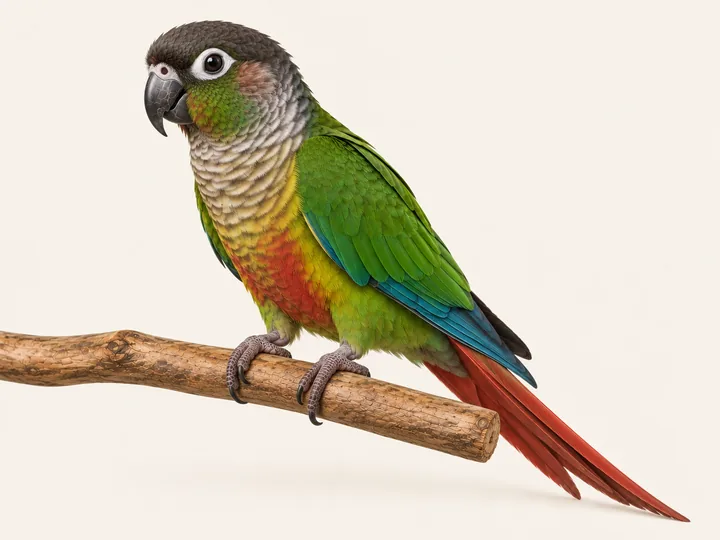
The green-cheek is the conure for people who cannot house a conure: most of the family announces itself like a car alarm, and this one mostly does not. What it keeps is the personality — a fearless, snuggly, pocket-sized clown that wants to be inside your shirt collar, in your cereal, and across every boundary you set. It is the closest thing the bird world has to a puppy that flies, and like a puppy it becomes a nippy little tyrant in households that think cute and consistent are opposites.
At a glance
- Lifespan
- 20–30 years
- Adult weight
- 60–80 g
- Daily attention
- 2–3 hrs of hands-on company
- Alone time tolerated
- Poor; this is a contact species
- Minimum housing
- Flight cage plus daily room time
- Noise level
- Moderate — quiet for a conure, not for a house
- Feather dust
- Low to moderate
- With children
- Good with calm children; beak is small but opinionated
- With other pets
- Not with cats
Mutations · 4 listed
Mutations abound — cinnamon, yellow-sided, turquoise, pineapple. Same bird, same needs, different upholstery.
-
Normal
-
Yellow-sided
-
Turquoise
-
Pineapple
Right for you if
- You want maximum parrot character in an apartment-plausible package.
- Daily hands-on time is a pleasure, for a couple of decades.
- You will set boundaries with a ten-gram beak and keep them.
- A bird in your collar, your pocket and your business sounds like company.
Wrong for you if
- You wanted a watch-from-the-sofa bird. This one does not do distance.
- Nobody is home most days.
- Consistency is not the household’s strong suit; nippiness is the bill for that.
- A cat lives in the house.
Welfare and sourcing — read this part
- Much of what ails pet birds starts in malnutrition — liver, kidney, respiratory and bone disease all trace back to it — and all-seed bowls are the classic route in.1 Ask what the breeder weans onto; a green-cheek raised on pellets and vegetables is a head start you cannot easily buy later.
- Overheated non-stick cookware releases fumes that kill birds quickly, and small birds go first.23
- Meet the bird before you buy it. Green-cheeks are individuals to an unusual degree, and ten minutes of handling tells you more than any mutation name or price tag.
Sources
- Hoppes SM. Nutritional Diseases of Pet Birds. MSD Veterinary Manual, professional edition. MSD Veterinary Manual 2026. Accessed 2026-08-31. International MSD Veterinary Manual Much of what ails pet birds starts in malnutrition — liver, kidney, respiratory, bone and reproductive disease. All-seed diets, and even half-seed half-pellet diets, are deficient in vitamin A. Sedentary birds on mainly seed show a high incidence of fatty liver disease and heart failure. Budgerigars on iodine-poor all-seed diets develop goitre, though fortified diets have made that uncommon.
- Wells RE, Slocombe RF. Acute toxicosis of budgerigars (Melopsittacus undulatus) caused by pyrolysis products from heated polytetrafluoroethylene: microscopic study. American Journal of Veterinary Research 1982; 43(7):1243-8. International PMID 7103206 Budgerigars exposed to fumes from heated non-stick coating developed severe necrotising, haemorrhagic pneumonitis. Heated uncoated aluminium was the control.
- Shuster KA, Brock KL, Dysko RC, DiRita VJ, Bergin IL. Polytetrafluoroethylene toxicosis in recently hatched chickens (Gallus domesticus). Comparative Medicine 2012; 62(1):49-52. International PMID 22330651 Mass mortality (92% and 80% of two groups) traced to PTFE-coated heat-lamp bulbs. Birds are highly sensitive to inhaled toxicants.
Every source here was checked, not recalled. Where this page makes a health statement and no source appears against it, that is not an oversight we have hidden — it means the claim is not yet sourced, and the build reports how many are in that state.
Availability, registration and keeping requirements differ from place to place. Check the rules where you live before you commit to any animal — we describe animals, not law.