Species · Bird
Galah
Eolophus roseicapilla
Australia’s pink-and-grey cockatoo, abundant across nearly the whole continent and in aviculture everywhere.
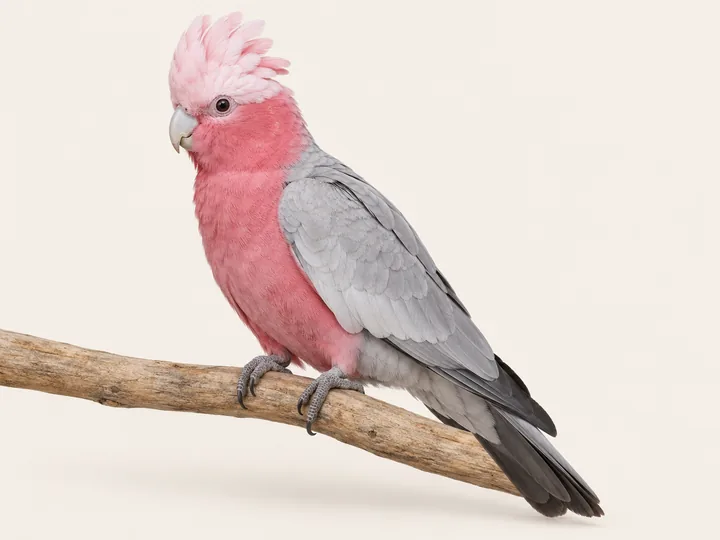
Anyone who has watched a flock of galahs hanging upside-down off a windmill in the rain already knows the temperament: this is a bird that plays. As a companion it is affectionate, robust, comparatively quiet for a cockatoo, and long enough lived to need succession planning. The species’ documented weakness in captivity is weight — a bird built for flying long paddocks between feeding grounds, sitting on a perch beside a seed bowl, fattens like clockwork. Feed it like an athlete and fly it daily, and the galah is arguably the best first cockatoo there is.
At a glance
- Lifespan
- 40–60 years
- Adult weight
- 270–350 g
- Daily attention
- 2–3 hrs of play and company
- Alone time tolerated
- Poor alone; a pair or your presence
- Minimum housing
- Aviary preferred; big cage plus daily flight at minimum
- Noise level
- Loud at dawn and dusk; modest for a cockatoo
- Feather dust
- High — powder down
- With children
- Good with supervised, respectful kids
- With other pets
- Not with cats
Mutations · 2 listed
The wild pink-and-grey is the bird; mutations exist in aviculture but change nothing about the keeping.
-
Pink & grey
-
Lutino
Right for you if
- You want a genuinely playful, affectionate cockatoo without full sulphur-crested volume.
- An aviary, or serious daily flight time, is available for the bird’s whole life.
- Weighing a bird weekly and rationing food sounds like sense, not fuss.
- A four-decade companion is a plan, not a surprise.
Wrong for you if
- The bird would sit caged beside a full seed bowl — this species pays for that fastest.
- Dawn is sacred and your windows are thin.
- Dust is a dealbreaker for lungs or furnishings.
- You want independence; a galah wants in on everything you do.
Welfare and sourcing — read this part
- Galahs are on the veterinary manual’s shortlist of species prone to obesity, with fatty liver disease as the complication.1 Rationed food, weighed birds and real flight are not extras for this species; they are the difference between forty good years and twenty poor ones.
- Beak and feather disease is the dominant viral pathogen of parrots in Australia, and all psittacine species are susceptible.2 For a cockatoo, buy only from a breeder who tests and shows you results — and keep a new bird quarantined from any existing ones.
- Overheated non-stick cookware releases fumes that kill birds quickly.34
- Native birds are kept under rules that differ by state, and the rules change. Check what applies where you live before you commit — the existence of the rules is the point; the details are your state’s to state.
Sources
- Nutritional Diseases of Pet Birds. MSD Veterinary Manual 2021. Accessed 2026-09-05. International MSD Veterinary Manual African grey parrots are prone to an acute hypocalcaemia syndrome, associated with low calcium and low vitamin D3, presenting as weakness, tremors and seizures; young greys can instead show bone deformity. Galahs, macaws, Amazon parrots and Quaker parrots are named as prone to obesity, with fatty liver disease as the complication.
- Raidal SR, Sarker S, Peters A. Review of psittacine beak and feather disease and its effect on Australian endangered species. Australian Veterinary Journal 2015. Australia doi:10.1111/avj.12388 PMID 26769072 Charles Sturt University review: since its description in the early 1980s, psittacine beak and feather disease has become recognised as the dominant viral pathogen of psittacine birds in Australia, with all psittacine species susceptible across virus genotypes, and it stands as a listed key threatening process for endangered parrots.
- Wells RE, Slocombe RF. Acute toxicosis of budgerigars (Melopsittacus undulatus) caused by pyrolysis products from heated polytetrafluoroethylene: microscopic study. American Journal of Veterinary Research 1982; 43(7):1243-8. International PMID 7103206 Budgerigars exposed to fumes from heated non-stick coating developed severe necrotising, haemorrhagic pneumonitis. Heated uncoated aluminium was the control.
- Shuster KA, Brock KL, Dysko RC, DiRita VJ, Bergin IL. Polytetrafluoroethylene toxicosis in recently hatched chickens (Gallus domesticus). Comparative Medicine 2012; 62(1):49-52. International PMID 22330651 Mass mortality (92% and 80% of two groups) traced to PTFE-coated heat-lamp bulbs. Birds are highly sensitive to inhaled toxicants.
Every source here was checked, not recalled. Where this page makes a health statement and no source appears against it, that is not an oversight we have hidden — it means the claim is not yet sourced, and the build reports how many are in that state.
Availability, registration and keeping requirements differ from place to place. Check the rules where you live before you commit to any animal — we describe animals, not law.