Species · Bird
Eclectus Parrot
Eclectus roratus
Rainforest parrot of New Guinea, nearby islands and far northern Australia — so dramatically dimorphic that the sexes were once described as different species.
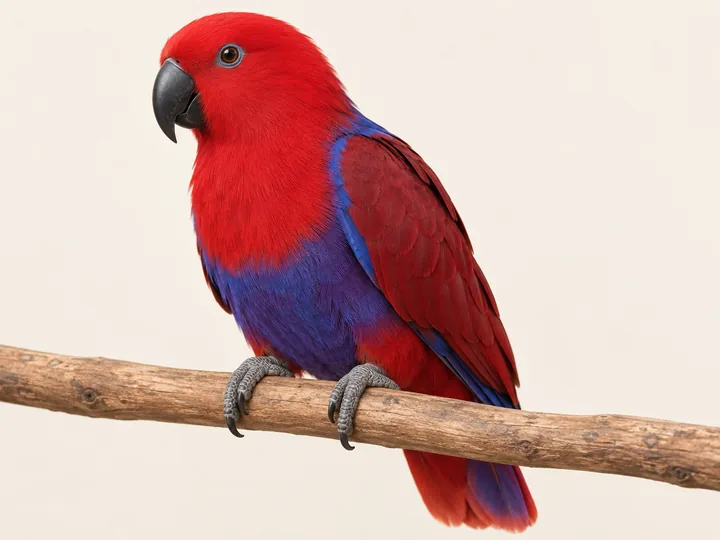
The eclectus is the calm one of the big parrots — measured, watchful, gentler than a cockatoo and far quieter than a macaw, with the party trick that cocks are brilliant green and hens brilliant red. The species’ quirk is the gut: these are fruit-and-fibre specialists from rainforest canopy, and the keeping tradition around them leans hard on fresh food. It is also one of the few birds on this page where the hen, not the cock, is the more strong-willed animal. A thinking person’s parrot, for a household that cooks vegetables anyway.
At a glance
- Lifespan
- 30–40 years
- Adult weight
- 380–550 g
- Daily attention
- 2–3 hrs of company daily
- Alone time tolerated
- Moderate for a large parrot
- Minimum housing
- Large cage plus daily room time
- Noise level
- Moderate, with a honk you will learn
- Feather dust
- Low — no powder down
- With children
- Calm older children, supervised
- With other pets
- Not with cats
Mutations · 2 listed
Not mutations — the sexes. Cocks are green with candy-corn beaks; hens are red and violet with black beaks. Know which you are buying, because the hens run the species.
-
Cock (green)
-
Hen (red & violet)
Right for you if
- You want a large parrot without a large parrot’s volume.
- Chopping vegetables daily for thirty years reads as routine, not burden.
- A composed, slightly formal bird appeals more than a clown.
- Low feather dust matters — allergies, or just the furniture.
Wrong for you if
- Pellets-and-forget was the feeding plan; this species is the wrong shortcut.
- You want a cuddly velcro bird. Eclectus affection is real but rationed.
- The household is loud chaos; this bird prefers an ordered room.
- A three-decade commitment is not actually on the table.
Welfare and sourcing — read this part
- Psittacine beak and feather disease still occurs in Eclectus parrots among other species, and it has no cure.1 Ask the breeder for the test result, in writing, before money moves.
- Much of what ails pet birds starts in malnutrition,2 and this is a species whose keeping tradition is built on fresh food and fibre. Ask any breeder to walk you through exactly what their adults eat in a day — the good ones answer in vegetables, not brands.
- Overheated non-stick cookware releases fumes that kill birds quickly.34 The eclectus lives where you cook its vegetables; mind the pans.
- Meet the actual bird and note which sex it is and how it was raised. With this species the hen is generally the firmer character — a first-time keeper is usually better matched with a cock.
Sources
- Skin and Feather Disorders of Pet Birds. MSD Veterinary Manual 2026. Accessed 2026-09-05. International MSD Veterinary Manual Psittacine beak and feather disease affects both wild and pet birds, still occurs in African grey parrots, Eclectus parrots, lovebirds, lorikeets and other Old-World parrots, and has no cure. On feather-destructive behaviour: causes span medical conditions and psychological problems, and malnutrition is likely one of the most common contributing factors.
- Hoppes SM. Nutritional Diseases of Pet Birds. MSD Veterinary Manual, professional edition. MSD Veterinary Manual 2026. Accessed 2026-08-31. International MSD Veterinary Manual Much of what ails pet birds starts in malnutrition — liver, kidney, respiratory, bone and reproductive disease. All-seed diets, and even half-seed half-pellet diets, are deficient in vitamin A. Sedentary birds on mainly seed show a high incidence of fatty liver disease and heart failure. Budgerigars on iodine-poor all-seed diets develop goitre, though fortified diets have made that uncommon.
- Wells RE, Slocombe RF. Acute toxicosis of budgerigars (Melopsittacus undulatus) caused by pyrolysis products from heated polytetrafluoroethylene: microscopic study. American Journal of Veterinary Research 1982; 43(7):1243-8. International PMID 7103206 Budgerigars exposed to fumes from heated non-stick coating developed severe necrotising, haemorrhagic pneumonitis. Heated uncoated aluminium was the control.
- Shuster KA, Brock KL, Dysko RC, DiRita VJ, Bergin IL. Polytetrafluoroethylene toxicosis in recently hatched chickens (Gallus domesticus). Comparative Medicine 2012; 62(1):49-52. International PMID 22330651 Mass mortality (92% and 80% of two groups) traced to PTFE-coated heat-lamp bulbs. Birds are highly sensitive to inhaled toxicants.
Every source here was checked, not recalled. Where this page makes a health statement and no source appears against it, that is not an oversight we have hidden — it means the claim is not yet sourced, and the build reports how many are in that state.
Availability, registration and keeping requirements differ from place to place. Check the rules where you live before you commit to any animal — we describe animals, not law.