Species · Bird
Cockatiel
Nymphicus hollandicus
Native to Australia, and the small cockatoo most people have actually met. Kept in captivity for well over a century.
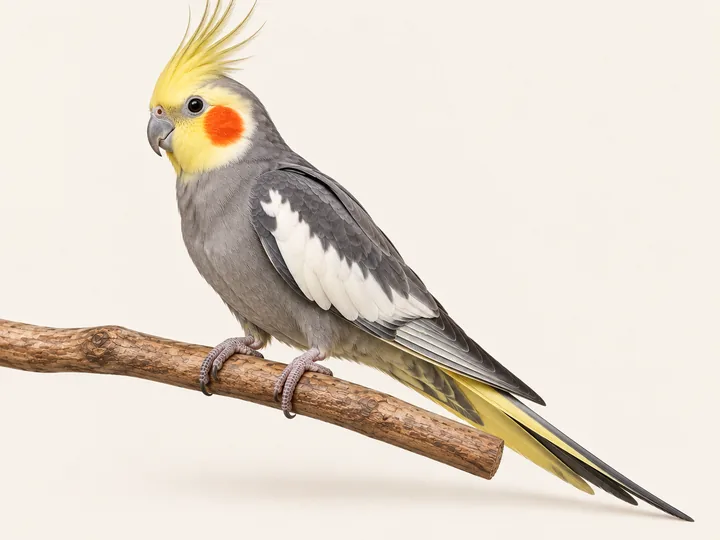
Cockatiels are gentle, cheap to buy and hard to do well. They live longer than most dogs, they are loud at dawn whether or not you are awake, and a single bird kept alone in a small cage is one of the most common quiet cruelties in pet keeping. Done properly they are superb. Done casually they are a bird sitting on a perch for twenty years.
At a glance
- Lifespan
- 15–25 years
- Adult weight
- 80–120 g
- Daily attention
- 2+ hrs out
- Alone time tolerated
- Keep in pairs
- Minimum housing
- Aviary preferred
- Noise level
- Loud at dawn
- Feather dust
- High
- With children
- Supervised only
- With other pets
- Not with cats
Mutations · 7 listed
Colour mutations combine freely, so most birds carry more than one. Naming them is breeder shorthand, not a care instruction — a lutino needs exactly what a normal grey needs.
-
Normal grey
-
Lutino
-
Pied
-
Pearl
-
Cinnamon
-
Whiteface
-
Fallow
Right for you if
- You can house at least two, with room to actually fly.
- You want a bird that is affectionate without being a project.
- A twenty-year commitment sounds reasonable to you.
- Nobody in the house needs a quiet sunrise.
Wrong for you if
- You have cats. This is not a problem you can manage away.
- You wanted a starter pet for a young child.
- Someone in the house has a respiratory condition — these birds produce a lot of dust.
- You are renting somewhere with thin walls.
Welfare and sourcing — read this part
- Feeding pure seed is one of the two most common causes of malnutrition in companion birds, and malnutrition is what sits underneath much of what goes wrong — liver, kidney, respiratory and bone disease all trace back to it.12 The other cause is subtler and just as common: give a bird a bowl it can pick through and it eats the seed and leaves the rest.1 Ask what the bird has been raised on before you buy it.
- Buy from someone who lets you see the aviary. Birds sold from a bare cage in a shop corner have usually already had a bad start.
- Wild-caught birds are not part of this hobby anywhere it is properly regulated. Captive-bred, always.
- Overheated non-stick cookware releases fumes that kill birds quickly.34 If you keep birds, this changes what you cook with.
Sources
- Hoppes SM. Management of Pet Birds — Nutrition. MSD Veterinary Manual, professional edition. MSD Veterinary Manual 2026. Accessed 2026-08-31. International MSD Veterinary Manual The two most common causes of malnutrition in companion birds are feeding pure seed, and feeding a bowl the bird can pick through — it eats the seed and leaves the rest. For small birds such as budgerigars and cockatiels the recommendation is 40 to 50% pellets and 30 to 40% seed mix, with vegetables and a little fruit. Large parrots are different, at 80% pellets.
- Hoppes SM. Nutritional Diseases of Pet Birds. MSD Veterinary Manual, professional edition. MSD Veterinary Manual 2026. Accessed 2026-08-31. International MSD Veterinary Manual Much of what ails pet birds starts in malnutrition — liver, kidney, respiratory, bone and reproductive disease. All-seed diets, and even half-seed half-pellet diets, are deficient in vitamin A. Sedentary birds on mainly seed show a high incidence of fatty liver disease and heart failure. Budgerigars on iodine-poor all-seed diets develop goitre, though fortified diets have made that uncommon.
- Wells RE, Slocombe RF. Acute toxicosis of budgerigars (Melopsittacus undulatus) caused by pyrolysis products from heated polytetrafluoroethylene: microscopic study. American Journal of Veterinary Research 1982; 43(7):1243-8. International PMID 7103206 Budgerigars exposed to fumes from heated non-stick coating developed severe necrotising, haemorrhagic pneumonitis. Heated uncoated aluminium was the control.
- Shuster KA, Brock KL, Dysko RC, DiRita VJ, Bergin IL. Polytetrafluoroethylene toxicosis in recently hatched chickens (Gallus domesticus). Comparative Medicine 2012; 62(1):49-52. International PMID 22330651 Mass mortality (92% and 80% of two groups) traced to PTFE-coated heat-lamp bulbs. Birds are highly sensitive to inhaled toxicants.
Every source here was checked, not recalled. Where this page makes a health statement and no source appears against it, that is not an oversight we have hidden — it means the claim is not yet sourced, and the build reports how many are in that state.
Availability, registration and keeping requirements differ from place to place. Check the rules where you live before you commit to any animal — we describe animals, not law.