Species · Bird
Blue-and-gold Macaw
Ara ararauna
Large macaw of South American river forest, the standard-bearer of the family in aviculture for a century.
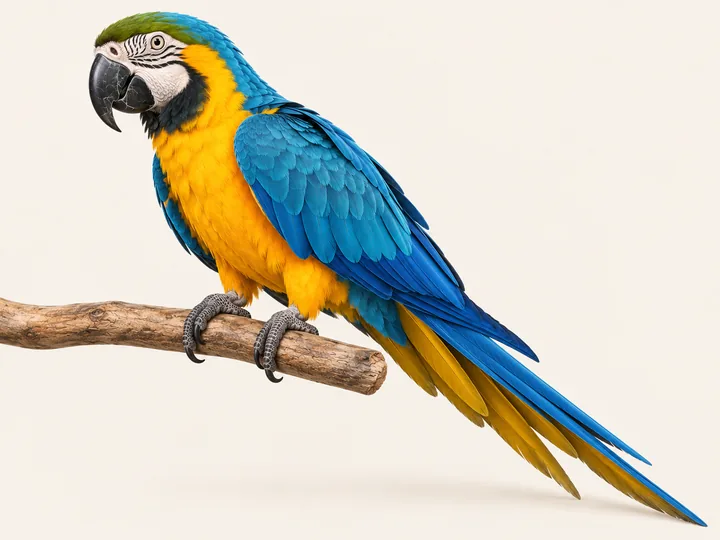
A macaw is not a bigger cockatiel; it is a different order of undertaking. The beak cracks brazil nuts, the call carries across a valley, the wingspan wants a room rather than a cage, and the calendar reads like adopting a toddler who will attend your retirement party. What you get back is a clownish, affectionate, physically spectacular companion that plays rough and loves hard. The honest question is not whether the bird is wonderful — it is whether any part of your housing, neighbours and next forty years is actually shaped like this.
At a glance
- Lifespan
- 40–60 years
- Adult weight
- 900–1300 g
- Daily attention
- 3+ hrs, physical and social
- Alone time tolerated
- Poor; bored macaws scream and strip
- Minimum housing
- Room-scale cage or aviary, non-negotiable
- Noise level
- Extreme — genuinely heard streets away
- Feather dust
- Moderate
- With children
- The beak outmatches supervision; older teens up
- With other pets
- Not with cats; dogs need serious management
Mutations · 1 listed
One wild colour — the blue and gold is the name, not a mutation. What varies is the individual bird, enormously.
-
Blue & gold
Right for you if
- You have detached housing, forgiving acreage, or a purpose-built aviary.
- Someone strong-nerved is home daily for the next several decades.
- The budget absorbs a room-scale enclosure, avian-vet care and a toy-destruction habit.
- You have met adult macaws at volume, in person, and still want this.
Wrong for you if
- You share a wall, a fence line, or a body corporate with anyone.
- The plan is a big cage in the lounge and out at weekends.
- Small children and a nutcracker beak share the house.
- You have never lived with a parrot before. Do not start here.
Welfare and sourcing — read this part
- Macaws are on the veterinary manual’s list of species prone to obesity, with fatty liver disease as the complication1 — and the large-parrot diet recommendation is about 80% pellets,2 not the nut-heavy mix the size of the beak suggests. Weigh the bird; do not eyeball a feathered kilogram.
- Overheated non-stick cookware releases fumes that kill birds quickly.34 It applies to a macaw exactly as to a budgerigar.
- Buy captive-bred with a hatch record from a breeder who will show you the aviary, the parents and the paperwork. A macaw is a decades-long witness to where it came from; a bad start takes years to undo.
- Before you commit, spend an hour beside an adult macaw at full voice. Sellers rarely arrange this; good breeders will. Treat reluctance as information.
Sources
- Nutritional Diseases of Pet Birds. MSD Veterinary Manual 2021. Accessed 2026-09-05. International MSD Veterinary Manual African grey parrots are prone to an acute hypocalcaemia syndrome, associated with low calcium and low vitamin D3, presenting as weakness, tremors and seizures; young greys can instead show bone deformity. Galahs, macaws, Amazon parrots and Quaker parrots are named as prone to obesity, with fatty liver disease as the complication.
- Hoppes SM. Management of Pet Birds — Nutrition. MSD Veterinary Manual, professional edition. MSD Veterinary Manual 2026. Accessed 2026-08-31. International MSD Veterinary Manual The two most common causes of malnutrition in companion birds are feeding pure seed, and feeding a bowl the bird can pick through — it eats the seed and leaves the rest. For small birds such as budgerigars and cockatiels the recommendation is 40 to 50% pellets and 30 to 40% seed mix, with vegetables and a little fruit. Large parrots are different, at 80% pellets.
- Wells RE, Slocombe RF. Acute toxicosis of budgerigars (Melopsittacus undulatus) caused by pyrolysis products from heated polytetrafluoroethylene: microscopic study. American Journal of Veterinary Research 1982; 43(7):1243-8. International PMID 7103206 Budgerigars exposed to fumes from heated non-stick coating developed severe necrotising, haemorrhagic pneumonitis. Heated uncoated aluminium was the control.
- Shuster KA, Brock KL, Dysko RC, DiRita VJ, Bergin IL. Polytetrafluoroethylene toxicosis in recently hatched chickens (Gallus domesticus). Comparative Medicine 2012; 62(1):49-52. International PMID 22330651 Mass mortality (92% and 80% of two groups) traced to PTFE-coated heat-lamp bulbs. Birds are highly sensitive to inhaled toxicants.
Every source here was checked, not recalled. Where this page makes a health statement and no source appears against it, that is not an oversight we have hidden — it means the claim is not yet sourced, and the build reports how many are in that state.
Availability, registration and keeping requirements differ from place to place. Check the rules where you live before you commit to any animal — we describe animals, not law.