Species · Bird
African Grey Parrot
Psittacus erithacus
Rainforest parrot of West and Central Africa, kept for centuries and studied for decades because of what its mind turned out to be.
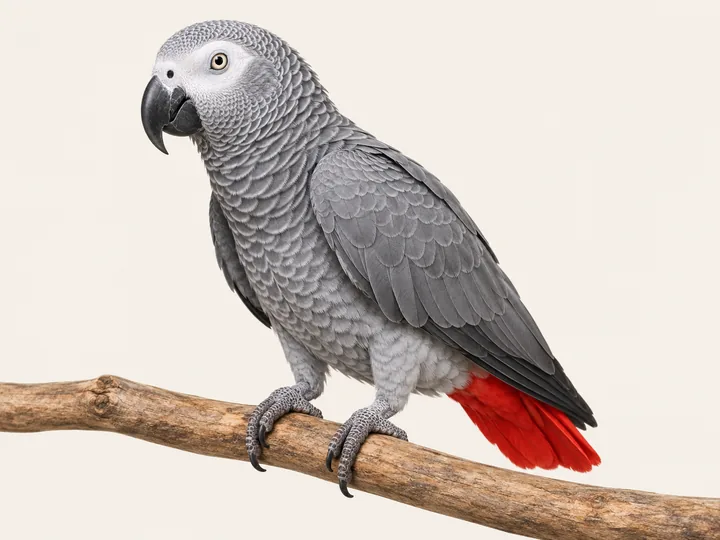
Everything you have heard about grey intelligence is true, and none of it is a selling point. A mind like that in a cage is a welfare project you take on for half a century: a grey bonds to its person like a colleague, reads a household like a barometer, and pays for boredom and neglect with its own feathers. This is the most rewarding companion bird in the hobby for someone whose life can hold it, and one of the most commonly rehomed for everyone else. The bird will likely outlive your working life. Plan like it.
At a glance
- Lifespan
- 40–60 years
- Adult weight
- 380–550 g
- Daily attention
- 3+ hrs of company and work daily
- Alone time tolerated
- Poor — a lonely grey is a plucking grey
- Minimum housing
- Large cage plus daily room time
- Noise level
- Moderate — a mimic, not a screamer
- Feather dust
- Very high — powder down
- With children
- A one-person bird; not a family toy
- With other pets
- Not with cats; careful with dogs
Mutations · 2 listed
The Congo grey with its scarlet tail is the bird most people mean; the smaller, darker Timneh is the same commitment in a quieter suit.
-
Congo
-
Timneh
Right for you if
- Someone is home most days, for decades, and wants a genuine companion mind.
- You will feed a proper diet and treat foraging and training as daily work, not enrichment extras.
- The estate planning question — who takes the bird — has an actual answer.
- Nobody in the house has a respiratory condition; the dust is real.
Wrong for you if
- The house is empty through the working day.
- You want a hands-off ornament that talks. The talking comes with the mind attached.
- A bird that may pick one person and merely tolerate the rest would hurt feelings.
- You are not ready to be outlived by a pet.
Welfare and sourcing — read this part
- Greys are prone to an acute hypocalcaemia syndrome — low calcium with low vitamin D3, showing as weakness, tremors and seizures — and in young birds bone deformity instead.1 Diet is the lever: for large parrots the recommendation is about 80% pellets,2 not the seed bowl most are still sold with.
- Psittacine beak and feather disease still occurs in African greys among other parrots, and it has no cure.3 Buy from a breeder who tests for it and will show you the result, not just say it.
- Overheated non-stick cookware releases fumes that kill birds quickly.45 A grey lives near your kitchen for fifty years; audit the pans before the bird arrives.
- Ask to see the parents and the weaning setup, and ask how much daily human time the chicks have had. A hand-reared grey that has learned people are safe is a different animal from one that has learned they are a delivery system for food.
Sources
- Nutritional Diseases of Pet Birds. MSD Veterinary Manual 2021. Accessed 2026-09-05. International MSD Veterinary Manual African grey parrots are prone to an acute hypocalcaemia syndrome, associated with low calcium and low vitamin D3, presenting as weakness, tremors and seizures; young greys can instead show bone deformity. Galahs, macaws, Amazon parrots and Quaker parrots are named as prone to obesity, with fatty liver disease as the complication.
- Hoppes SM. Management of Pet Birds — Nutrition. MSD Veterinary Manual, professional edition. MSD Veterinary Manual 2026. Accessed 2026-08-31. International MSD Veterinary Manual The two most common causes of malnutrition in companion birds are feeding pure seed, and feeding a bowl the bird can pick through — it eats the seed and leaves the rest. For small birds such as budgerigars and cockatiels the recommendation is 40 to 50% pellets and 30 to 40% seed mix, with vegetables and a little fruit. Large parrots are different, at 80% pellets.
- Skin and Feather Disorders of Pet Birds. MSD Veterinary Manual 2026. Accessed 2026-09-05. International MSD Veterinary Manual Psittacine beak and feather disease affects both wild and pet birds, still occurs in African grey parrots, Eclectus parrots, lovebirds, lorikeets and other Old-World parrots, and has no cure. On feather-destructive behaviour: causes span medical conditions and psychological problems, and malnutrition is likely one of the most common contributing factors.
- Wells RE, Slocombe RF. Acute toxicosis of budgerigars (Melopsittacus undulatus) caused by pyrolysis products from heated polytetrafluoroethylene: microscopic study. American Journal of Veterinary Research 1982; 43(7):1243-8. International PMID 7103206 Budgerigars exposed to fumes from heated non-stick coating developed severe necrotising, haemorrhagic pneumonitis. Heated uncoated aluminium was the control.
- Shuster KA, Brock KL, Dysko RC, DiRita VJ, Bergin IL. Polytetrafluoroethylene toxicosis in recently hatched chickens (Gallus domesticus). Comparative Medicine 2012; 62(1):49-52. International PMID 22330651 Mass mortality (92% and 80% of two groups) traced to PTFE-coated heat-lamp bulbs. Birds are highly sensitive to inhaled toxicants.
Every source here was checked, not recalled. Where this page makes a health statement and no source appears against it, that is not an oversight we have hidden — it means the claim is not yet sourced, and the build reports how many are in that state.
Availability, registration and keeping requirements differ from place to place. Check the rules where you live before you commit to any animal — we describe animals, not law.